


Midway through 2026, one characteristic continues to define the South African consumer, namely resilience.
South African households have had to navigate a prolonged period of economic pressure characterised by modest economic growth, high unemployment, elevated living costs, constrained disposable income and considerable domestic and international uncertainty. Yet the findings of the Bureau of Market Research’s Macroeconomic and Retail Trade Sales Forecast for South Africa, 2026 suggest that consumers have not simply retreated from the marketplace. Instead, they have adapted with respect to how, where and on what they spend.
This distinction is important. Consumer resilience should not be confused with consumer financial comfort. Many households remain under considerable pressure. Rather, resilience is increasingly reflected in the ability of consumers to adjust their behaviour, reprioritise expenditure and extract greater value from every rand available to them.
Retail Growth Despite A Constrained Economy
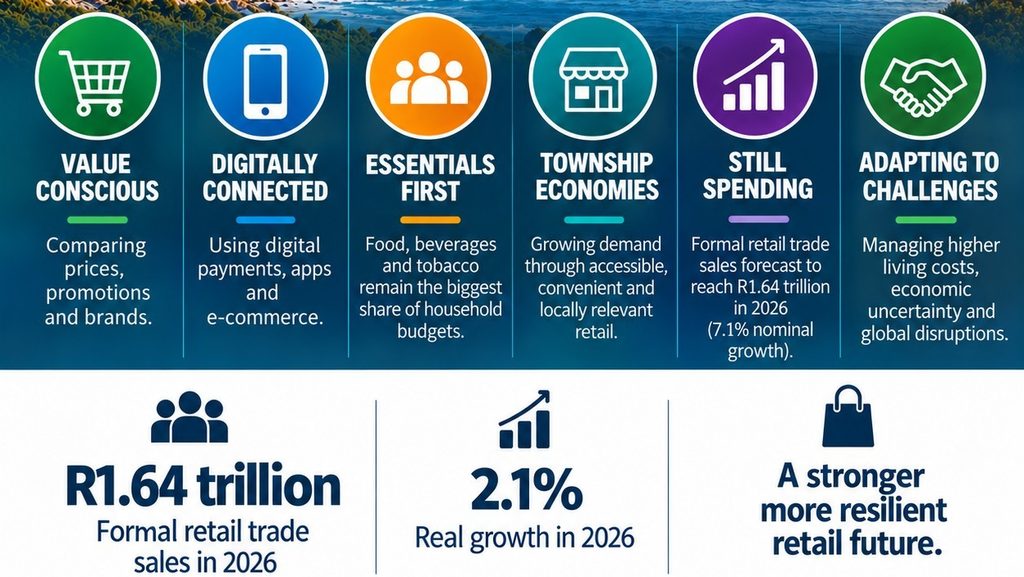
The BMR’s baseline forecast anticipates real GDP growth of approximately 1.4% in 2026, while real household consumption expenditure is projected to grow by around 1.9%. Against this relatively subdued economic backdrop, formal retail trade sales are nevertheless forecast to reach approximately R1.639 trillion in current prices during 2026, representing nominal growth of 7.1% and real growth of approximately 2.1%. These numbers tell an important story. Retail growth is continuing even though consumers are operating in an environment where income and employment opportunities remain constrained. The explanation is increasingly found not simply in how much consumers spend, but in how they spend it.
From Spending More To Spending Smarter
Perhaps the clearest manifestation of consumer resilience in 2026 is the rise of the value-conscious consumer. Value-for-money has moved beyond being primarily a lower-income consideration. Consumers across income groups are becoming more deliberate about purchases. They are comparing prices, switching between brands and retailers, making greater use of promotions and loyalty programmes, considering private-label alternatives and postponing purchases where the perceived value proposition is inadequate. This creates a consumer who may be financially constrained but is also increasingly informed, selective and empowered.
For retailers, this changes the basis of competition. The cheapest product does not necessarily represent the strongest value proposition. Consumers increasingly assess the combination of price, quality, convenience, service, accessibility and trust. Those retailers that can consistently deliver against this broader definition of value are likely to command an increasing share of household expenditure.
Essentials Remain At The Centre of Household Budgets
The composition of household expenditure also demonstrates how consumers are adapting. Approximately three-quarters of retail expenditure is directed towards non-durable goods, while food, beverages and tobacco remain the dominant expenditure category. This reflects the reality that, regardless of economic conditions, households must continue purchasing essential goods.
At the same time, the BMR forecast points towards selective recovery in more discretionary categories. Real retail sales growth during 2026 is projected to be particularly strong for household furniture, appliances and equipment at 5.7%, followed by clothing and footwear at 5.1%. This suggests that consumers are not abandoning discretionary spending altogether. Instead, purchases are increasingly being prioritised, postponed, compared and undertaken when households perceive that sufficient value exists.
Technology Is Becoming Part of Consumer Resilience
Another important dimension of resilience is technological adaptation. The South African consumer is progressively migrating towards digital payments, e-commerce, retailer applications and omnichannel shopping. Cash remains important, particularly in parts of the informal and township economies, but the longer-term direction is towards a more digitally enabled consumer marketplace. Technology gives consumers new mechanisms for managing financial pressure. A smartphone can increasingly become a price-comparison tool, payment instrument, loyalty card, banking platform and online marketplace simultaneously.
Consumers can compare prices before entering a store, receive personalised promotions, move between physical and online channels and identify bargains more efficiently. Digitalisation should therefore not be viewed only as a retail technology trend. It is increasingly becoming part of how households manage constrained resources.
Township Retail Is Part of The Structural Transformation
The continuing development of township and informal retail markets provides another important dimension to the changing consumer landscape. Proximity, convenience, familiarity and responsiveness to local consumer needs remain powerful competitive advantages. As township economies develop and retail formats evolve, they represent an increasingly important part of South Africa’s broader consumer market. The implication for established retailers is significant, namely future growth cannot be understood exclusively through conventional shopping centres and established formal retail channels. Therefore, successful retailers will increasingly need to understand consumers where they live, work, travel and transact.
Resilience Does Not Eliminate Vulnerability
It would, however, be inappropriate to interpret continued consumer spending as evidence that household financial pressures have disappeared. South Africa’s persistently high unemployment rate remains one of the greatest constraints on sustainable consumer-market growth. Household finances also remain vulnerable to renewed inflation, higher energy and transport costs, interest-rate pressures and economic shocks.
International developments add another layer of uncertainty. Geopolitical conflict and disruptions to international trade routes can translate into higher oil prices, freight costs and imported inflation. A weaker rand can further increase the domestic cost of imported consumer goods. These pressures can rapidly migrate through supply chains and ultimately reach households at the checkout counter. The BMR’s scenario analysis consequently recognises considerable uncertainty around the baseline outlook, namely real retail growth could range from −0.7% under the low-growth scenario to 5.4% under the high-growth scenario, compared with 2.1% in the baseline forecast. Resilience should therefore not be interpreted as invulnerability.
What Does This Mean For Retailers?
For businesses, the resilient consumer presents both an opportunity and a warning. Consumers will continue spending, but increasingly on their own terms. Retail businesses positioned to succeed will be those capable of combining several attributes compelling value-for-money, efficient supply chains, competitive pricing, relevant loyalty propositions, strong digital capabilities, convenient physical and online channels, and an increasingly sophisticated understanding of customer behaviour. Retailers should also recognise that resilience works both ways. Just as consumers have learned to adapt to economic shocks, retailers need the operational flexibility to respond to exchange-rate movements, supply disruptions, changing purchasing patterns and shifts between product categories and retail channels.
The Consumer Should Never Be Underestimated
Perhaps the most important conclusion midway through 2026 is therefore a relatively simple one, namely never underestimate the South African consumer. Resilience is no longer merely about continuing to spend during difficult economic periods. It is increasingly about adaptability. Consumers are changing brands, channels, payment methods and shopping behaviours. They are using technology more effectively. They are demanding greater value. They are distinguishing more carefully between wants and needs. And they are rewarding businesses that understand the realities of their household budgets.
The BMR’s forecast of approximately R1.64 trillion in formal retail trade sales during 2026 therefore represents more than a retail number. It reflects the collective purchasing decisions of millions of households continually adapting to a changing economic environment. South Africa’s consumer economy undoubtedly remains vulnerable to unemployment, inflation, geopolitical uncertainty and weak economic growth. But the evidence also points to a consumer who has become more discerning, more digitally connected, more value-conscious and remarkably adaptable.
That resilience remains one of the strongest foundations supporting South Africa’s retail economy in 2026, and will be an important force shaping its future.
We welcome your comments and invite you to share your views on our Facebook page.
Compiled by: Prof DH Tustin & Prof CJ van Aardt
23 September 2026