

Credit can help South Africans meet today’s needs, but could it be putting tomorrow’s financial security at risk?
Introduction
Consumer credit is an important component of South Africa’s financial system. It enables households to smooth consumption, meet emergencies and finance major purchases such as homes, vehicles and education. Credit can also support financial inclusion and asset formation when used responsibly. However, borrowing creates repayment obligations that compete directly with saving for a share of disposable income. Where credit is costly, repeatedly used for consumption or poorly matched to household resources, debt servicing can weaken emergency savings, retirement provision and long-term wealth accumulation.
This blog post examines the relationship between consumer credit and household saving in South Africa. It brings together recent evidence on household debt, debt-service costs, saving and credit-market participation, it considers how different credit instruments may affect household finances and it presents a conceptual model showing the pathways through which credit can either constrain or support household saving. The central argument is that the effect of credit is not inherently negative, namely it depends on the cost, purpose and structure of borrowing, as well as on other variables such as household income, financial capability and the wider economic environment.
South African Consumer Credit and Household Saving Context
Recent data point to a difficult balance between broad access to credit and limited household saving buffers. According to the South African Reserve Bank (SARB), household debt to disposable income ratio rose to 62.2% in the first quarter of 2026 compared to 61.8% in the fourth quarter of 2025, while debt-service costs remained at 8.4% as a ratio of disposable income. Gross household saving averaged only 1.4% of GDP in 2025 and declined to 1.2% in the fourth quarter of that year (SARB, 2026a; SARB, 2026b).
Credit-market statistics reinforce the scale of household exposure. The National Credit Regulator (NCR) recorded 29.24 million credit-active consumers at the end of June 2025, of whom 10.54 million, or 36.05%, had impaired credit records. In the second quarter of 2025, R24.47 billion in credit facilities was granted. Credit and garage cards accounted for R11.36 billion, while store cards accounted for R6.85 billion. Store cards also represented 76.3% of the number of new credit-facility agreements, illustrating the prevalence of readily accessible retail credit (NCR, 2025a; NCR, 2025b).
| Indicator | Latest period | Statistic | Implication for household saving |
| Household debt to disposable income ratio | Q1 2026 | 62.2% | A high debt stock can increase the share of income committed to repayment. |
| Debt-service cost / disposable income | Q1 2026 | 8.4% | Debt servicing directly reduces income available for precautionary and long-term saving. |
| Gross household saving / GDP | 2025 | 1.4% | Indicates a narrow household saving buffer at the macroeconomic level. |
| Credit-active consumers | June 2025 | 29.24 million | Shows the broad reach of formal consumer credit. |
| Consumers with impaired records | June 2025 | 10.54 million (36.05%) | Signals repayment pressure and financial vulnerability among a substantial share of consumers. |
| Credit facilities granted | Q2 2025 | R24.47 billion | Shows continued use of revolving and retail credit by households. |
How Different Credit Instruments May Affect Saving
South African consumers can access both secured and unsecured credit through banks, retailers, fintech providers and microfinance institutions. Common products include store accounts, credit cards, personal loans, vehicle finance, home loans, overdraft facilities and Buy-Now-Pay-Later (BNPL) services. Digital applications and mobile platforms have reduced transaction friction and made some forms of credit easier to access. The effect on saving, however, differs according to the product’s cost, repayment profile and purpose.
| Credit instrument | Likely effect on saving | Main channel |
| Store accounts | Generally negative when used repeatedly for discretionary consumption. | Fees, interest and frequent retail purchases can reduce disposable income and delay saving. |
| Personal loans | Potentially negative, especially where borrowing is recurrent or at high-cost. | Fixed repayments and interest obligations can crowd out monthly saving. |
| Credit cards | Negative when balances revolve; neutral or limited where settled in full. | Revolving balances can increase interest costs and encourage current consumption. |
| BNPL services | Potentially negative for short-term saving when used for discretionary purchases. | Immediate consumption is brought forward, creating future payment commitments. |
| Vehicle finance | Often negative for liquid savings, although it may support mobility and employment | Repayments, insurance and maintenance reduce disposable income while the asset depreciates. |
| Home loans | Reduces short-term cash savings but can support long-term wealth formation. | Mortgage repayments build housing equity, although they constrain current disposable income. |
| Overdraft facilities | Potentially negative when used persistently. | Recurring use can convert short-term liquidity support into an ongoing debt burden. |
Mechanisms Linking Credit Use and Household Saving
Credit affects saving through several closely related mechanisms. First, debt repayments and interest charges reduce the portion of disposable income available for emergency funds, retirement contributions and other forms of financial saving. Second, easy access to revolving or retail credit can bring future consumption into the present, weakening the incentive to delay purchases and save beforehand. Third, the accumulation of several repayment commitments can increase financial vulnerability and reduce a household’s ability to absorb income shocks.
The relationship is nevertheless conditional. Credit used to acquire productive assets, finance educational endeavors or support viable business activity may strengthen future earning capacity and wealth. Mortgage finance may also substitute for some liquid savings by building housing equity over time. In addition, access to emergency credit can help households avoid selling assets or drawing down long-term investments during temporary financial stress. A robust assessment therefore needs to distinguish consumption-oriented borrowing from credit that contributes to asset formation or future income.
Figure 1: Consumer Credit and Household Savings Model in South Africa
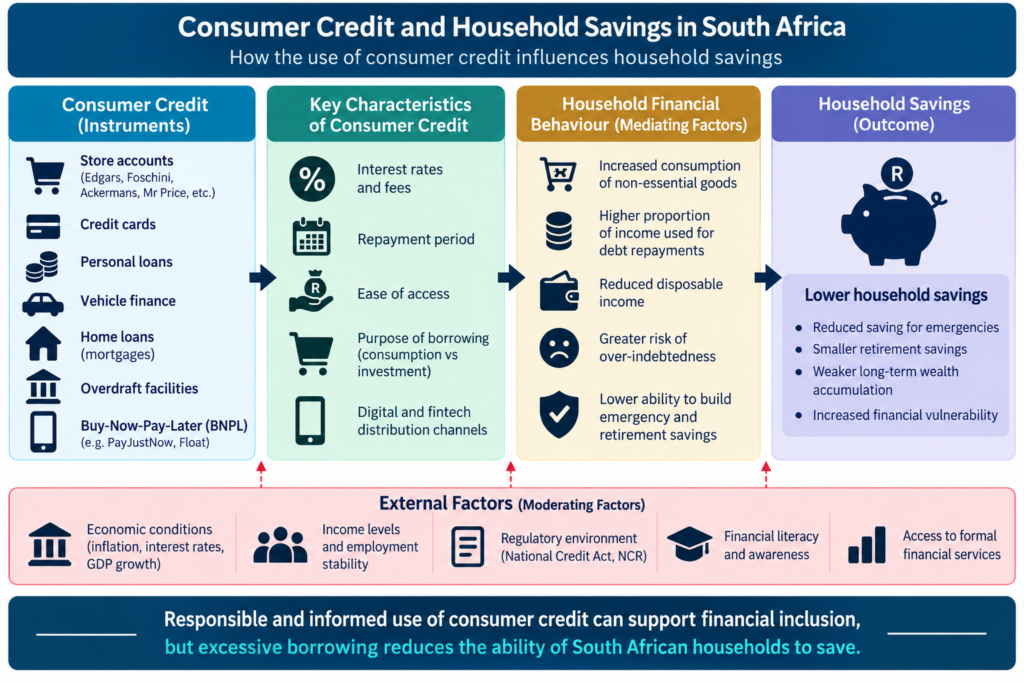
Figure 1 illustrates that credit instruments differ in interest rates and fees, repayment periods, accessibility, intended use and distribution channels. These characteristics shape borrowing and consumption behaviour and influence the stock of household debt and the size of monthly repayment commitments. As debt-service obligations rise, disposable income can be compressed, reducing households’ capacity to build emergency, retirement and other forms of financial saving. The result may be greater vulnerability to income or expenditure shocks.
The framework also recognises that these relationships do not operate in isolation. Income and employment stability, inflation and living costs, interest rates, financial literacy, access to formal financial services, the regulatory environment and broader macroeconomic conditions can strengthen or weaken the effect of credit on saving. The framework therefore supports three propositions, namely:
- higher debt-service burdens tend to reduce saving capacity;
- readily accessible revolving and retail credit can shift expenditure from future to current consumption; and
- the ultimate effect of credit depends on its cost, purpose and contribution to future income or asset formation.
Recent Trends and Emerging Pressures
Developments between 2021 and 2026 point to sustained credit use alongside weak household saving buffers. Digital finance has made some short-term credit products more accessible, while the size of the credit-active population demonstrates the broad reach of formal borrowing. At the same time, gross household saving has remained low and more than one-third of credit-active consumers recorded impaired credit records by June 2025. These indicators suggest that wider access to credit has not been matched by a comparable strengthening of household financial buffers.
Households also face pressures that can constrain saving independently of credit. High unemployment, income inequality and increases in the cost of food, transport, electricity and other essentials reduce the income available for both debt repayment and savings. Financial literacy remains important because consumers must assess the full cost of borrowing, manage several repayment commitments and distinguish between credit that supports longer-term financial goals and credit that finances short-lived consumption.
Implications For Households, Lenders and Policymakers
The evidence points to the need for a balanced approach. Credit plays a legitimate role in consumption smoothing, financial inclusion, emergency cover and asset formation, but its benefits depend on affordability and responsible use. For households, stronger budgeting, debt management and automatic saving mechanisms can help preserve saving habits even when repayment obligations are present. For lenders, rigorous affordability assessment and clear disclosure of the total cost of credit remain central to responsible lending.
Technology may create both opportunities and risks. Digital platforms can make credit faster available and more convenient, but the same technologies can also support monitoring expenditure, automated transfers into savings accounts and more tailored financial guidance. Regulatory and consumer-education initiatives should therefore aim not simply to restrict credit, but to improve the quality of borrowing decisions and strengthen household resilience.
Conclusion
Consumer credit has a material influence on household saving in South Africa because debt repayments, interest costs and consumption choices determine how much disposable income remains available for saving. The conceptual framework presented above shows why the relationship between credit and saving should not be treated as uniformly negative. Consumption-oriented, high-cost or repeatedly used credit can crowd out both short- and long-term saving, whereas credit that builds assets or strengthens future income may contribute to wealth creation. Improving household financial resilience therefore requires responsible lending, realistic affordability assessment, stronger financial capability and deliberate saving mechanisms that operate alongside, rather than after, credit commitments.
The implication of this is that credit is neither inherently good nor bad. Its impact ultimately depends on how much households borrow, what they borrow for, what such debt costs and whether sufficient income remains to save for tomorrow. For South African households, the challenge is therefore not simply to gain access to credit, but to achieve a sustainable balance between meeting today’s financial needs and protecting tomorrow’s financial resilience. In an environment of persistent cost-of-living pressures and relatively weak household saving, that balance has never been more important. The question worth asking is therefore a simple one: Is the credit we use today helping us build tomorrow’s financial security – or borrowing from it?
References
South African Reserve Bank (SARB). (2026a). Quarterly Bulletin, March 2026. Pretoria: SARB.
South African Reserve Bank (SARB). (2026b). Quarterly Bulletin, June 2026. Pretoria: SARB.
National Credit Regulator (NCR). (2025a). Credit Bureau Monitor: Second Quarter, June 2025. Midrand: NCR. National Credit Regulator (NCR). (2025b). Consumer Credit Market Report: Second Quarter, June 2025. Midrand: NCR.
We welcome your comments and invite you to share your views on our Facebook page.
Compiled by: Mr A Risenga, Prof CJ van Aardt & Prof DH Tustin
17 September 2026