

South Africa’s Personal Income Has Grown, But Real Income Per Adult Remains Below 2011 Levels
South Africa’s personal income economy has expanded substantially over the past 15 years, but the gains remain concentrated among a relatively small share of adults, according to the Bureau of Market Research’s latest Personal Income Estimates for South Africa, 2011–2026 (BMR Report 551).
The BMR estimates that total personal income increased from R2.71 trillion in 2011 to R6.70 trillion in 2025. Personal cash flow income, representing income available for current spending and consumption, rose from R2.39 trillion to R5.92 trillion. This translates to total and cash flow income growing more than four times as fast as the adult population (15 years and older), which increased by 34.1% over the period.
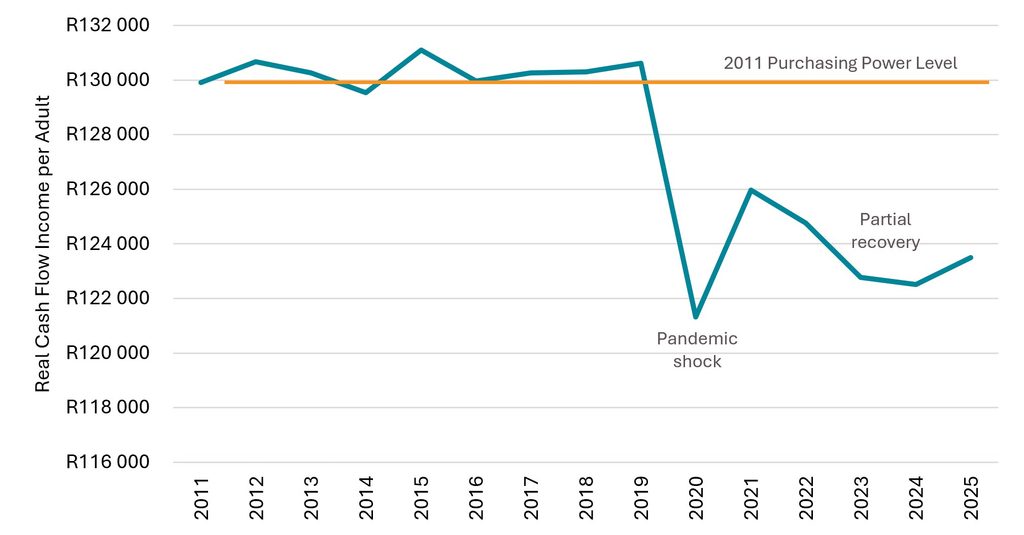
However, aggregate income growth does not reflect the experience of the typical South African adult. In 2025, average annual personal cash flow income was estimated at R123 492 per adult, while median personal cash flow income, the income received by the adult at the middle of the distribution, was R27 122. The average adult therefore received about 4.6 times the personal income of the typical adult. Furthermore, despite a 148% increase in nominal cash flow income between 2011 and 2025, real cash flow income per adult declined by approximately 5% over the same period.
“The expansion of South Africa’s personal income economy is real, but it should not be confused with broad-based improvement in individual economic wellbeing,” said Prof Deon Tustin, BMR Chief Executive Officer. “How personal income is distributed matters as much as how much income is generated. It shapes individual purchasing power, consumer markets and the opportunity available to participate in economic growth.”
A larger income economy, but not greater purchasing power
Source: BMR Report 551 (2025 estimates)
The report shows that the top 10% of adults received 67.4% of national personal cash flow income in 2025, while the bottom half of adults received about 3%. Less than 7% of adults controlled almost 60% of national personal cash flow income.
This concentration has important implications for business, policy and economic planning. Population size alone is not a reliable measure of market potential, because personal income and spending capacity are concentrated within relatively small segments of the adult population. For policymakers, the findings reinforce the importance of employment, education and asset ownership in broadening participation in income growth.
Education remains the strongest predictor of personal income outcomes. Adults with tertiary education represented 12.7% of the adult population in 2025 but accounted for 48.8% of personal cash flow income. Adults without completed secondary education accounted for almost half of adults but received less than one-fifth of personal cash flow income.
The geography of personal income is similarly uneven. Gauteng and the Western Cape together generated 59.8% of national personal cash flow income in 2025, despite accounting for 39.7% of the adult population.
The report introduces the Income Share Index, a BMR measure that compares a province’s share of national personal income with its share of the adult population. An index above 1 indicates that a province generates a disproportionately large share of personal income relative to its adult population. In 2025, the Western Cape recorded an Income Share Index of 2.09, generating 26.3% of national personal cash flow income from 12.6% of the adult population. Gauteng recorded an index of 1.24. All other provinces recorded an index below 1.
“South Africa is a large market by population, but it is a highly concentrated market by personal income and purchasing power,” said Jacolize Meiring, Head of Personal Finance Research at the BMR. “Understanding who earns personal income, where it is earned and how it is distributed is essential for realistic market assessment and for policies aimed at widening economic opportunity.”
Personal income is concentrated in Gauteng and the Western Cape
An Income Share Index above 1 means a province generates a larger share of national personal cash flow income than its share of the adult population.

Source: BMR Report 551 (2025 estimates)
The 2026 outlook points to continued aggregate personal income growth, expected to exceed growth in the adult population. Without stronger real income growth, broader labour-market participation and wider access to education and assets, however, the structure of income concentration is expected to remain largely unchanged.
Report Key Findings

Methodology note
The BMR’s Income and Expenditure Model produces estimates of individual personal income in South Africa. It integrates individual and household-level data from Statistics South Africa official surveys with an updated BMR population-estimation framework and South African Reserve Bank national-account benchmarks. The 2026 edition incorporates revised spatial population modelling, demographic calibration and monetary weights. Historical estimates from 2011 onwards have therefore been recalculated to provide a consistent reference series and may differ from figures published in earlier BMR editions.
About the Report
BMR Report 551 shows strong growth in aggregate personal income since 2011, alongside persistent income concentration and a decline in real personal cash flow income per adult.
Report authored by: Ms J Meiring