


South African Consumers Face Cautious Recovery As Value, Affordability And Resilience Define the 2026–2028 Outlook
Moderate retail growth and more stable macroeconomic conditions provide some support to South African consumers, but weak employment, household financial pressure and persistent uncertainty are expected to keep spending cautious, selective and value-conscious.
The Bureau of Market Research (BMR) at the University of South Africa (Unisa) has released its Consumer Market Outlook: 2026 to 2028 (Report 550), which finds that the South African consumer market faces a cautiously positive but constrained outlook.
According to Dr Requier Wait (Chief Researcher), consumer spending is expected to benefit from more stable macroeconomic conditions, improving formal-sector earnings, digital adoption and positive retail growth. However, high unemployment, weak labour absorption, household financial pressure, infrastructure constraints and uncertainty continue to limit the strength and breadth of the recovery.
The outlook is therefore for households to remain selective in how and where they spend, placing greater emphasis on affordability, value, convenience, promotions, loyalty benefits and trust.
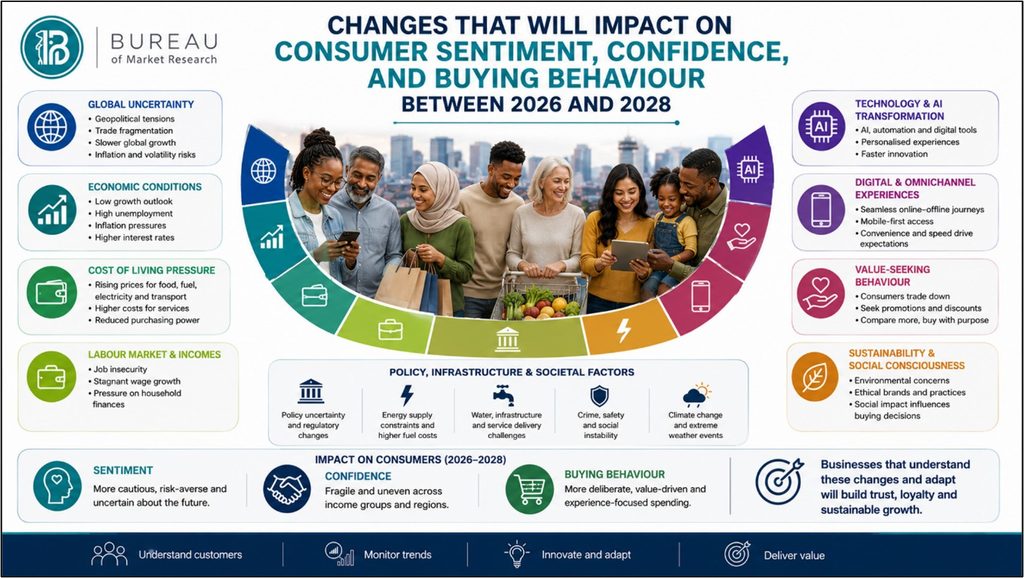
Importantly, the outlook is not being shaped by a single economic trend or shock, according to Wait. Instead, the BMR identifies the interaction of global uncertainty, domestic structural constraints and changing consumer behaviour as the defining context for the market. Geoeconomic fragmentation, slower global growth, energy and fuel-price volatility, inflation and interest-rate sensitivity, AI and data-driven transformation, value-seeking behaviour, digital and omnichannel retail, and climate, water and infrastructure risks are all expected to influence consumer sentiment, confidence and buying behaviour through to 2028.
For businesses, this creates a market that is recovering gradually, but remains cautious, price-sensitive and uneven across income groups and product categories.
Figure 1: Changes that will impact on consumer sentiment, confidence and buying behaviour between 2026 and 2028
Source: Bureau of Market Research, Consumer Market Outlook: 2026 to 2028, Report 550.
Taken together, these forces point to consumers becoming more cautious and selective, with confidence remaining uneven across households, and spending becoming increasingly deliberate, value-driven and experience-focused.
Consumer Market Outlook At A Glance
The outlook combines the May 2026 BMR/Unisa Economist of the Year consensus expectations for 2026 with BMR retail sales forecasts through to 2028.
- 1.2% expected real GDP growth in 2026
- 2.1% expected real retail trade sales growth in 2026
- 2.6% expected real retail trade sales growth by 2028
- Eight interconnected trends are reshaping the consumer environment, ranging from global fragmentation and cost pressures to AI, digital retail and changing value expectations.
A Recovery – But Not A Strong Consumer Rebound
South Africa’s macroeconomic environment is more stable than during the immediate post-pandemic and high-inflation period, but economic growth remains too weak to generate a broad-based consumer rebound. The report considers several alternative GDP growth forecasts, all pointing to a common conclusion: economic activity is expected to remain positive, but not sufficiently strong to meaningfully reduce unemployment or support a broad-based consumer acceleration.
Higher Earnings Support Spending – But Employment Weakness Limits The Recovery
Improving formal-sector earnings provide some support to household consumption. However, weak employment growth means that the benefits of higher earnings are not being shared broadly across the consumer market. The result is an uneven spending recovery: employed and higher-income households are likely to have greater capacity to spend, while unemployed and financially stressed households remain highly price-sensitive and focused on affordability and essential spending.
Value-Seeking Becomes a Dominant Consumer Behaviour Theme
Against this backdrop, the report identifies value-seeking as a dominant consumer behaviour theme for 2026.
Consumers are expected to compare prices more actively, seek promotions, use loyalty rewards, trade down to cheaper alternatives, buy private-label products, shift between formal and informal channels and delay discretionary purchases.
Importantly, value-seeking does not only mean buying the cheapest product. It reflects a wider assessment of price, quality, convenience, trust, availability, delivery cost, loyalty benefits and perceived usefulness.
For retailers and consumer brands, this means competing on value architecture, not only price, including pack sizes, promotions, loyalty benefits, private label, channel convenience and clear communication of product value.
Retail Growth Remains Positive, But Uneven
BMR forecasts indicate that total real retail trade sales growth is expected to remain positive, increasing from 2.1% in 2026 to 2.6% in 2028.
The strongest growth is expected in household furniture, appliances and equipment, together with textiles, clothing, footwear and leather goods. General dealers are expected to remain resilient, supported by scale, convenience and essential household spending.
Food-related specialised retailers and hardware, paint and glass retailers are expected to remain under pressure in real-volume terms. The retail outlook therefore points to moderate aggregate growth, but a recovery that is not evenly distributed across product categories.
Global Uncertainty Continues To Filter Down To Households
The South African consumer cannot be viewed separately from the wider risk environment. The report highlights geoeconomic confrontation, state-based armed conflict, extreme weather events, societal polarisation, and misinformation and disinformation among the major global risks shaping the outlook. Policy uncertainty also remains elevated. For South Africa, elevated uncertainty can translate into weaker investment, slower job creation, exchange-rate volatility, imported inflation, fuel and food-price pressures, higher financing costs and more cautious discretionary spending. The report therefore interprets uncertainty primarily as a growth-dampening force.
Technology Is Changing How Consumers Search, Buy And Pay
Alongside these economic pressures, rapid technological change is reshaping the consumer journey. Consumers increasingly combine digital search, price comparison, physical stores, e-commerce platforms, delivery, click-and-collect and digital payments. Artificial intelligence is also becoming increasingly important in forecasting, pricing, customer segmentation, inventory planning, logistics, marketing and customer service.
For consumer-facing businesses, AI creates opportunities to personalise offers, predict demand and improve omnichannel operations, but the report also highlights challenges relating to data readiness, skills, governance, trust and cyber risk. Businesses that combine good data, consumer insight and execution discipline, while strengthening digital payments, customer data, loyalty and fulfilment capabilities, are likely to be better positioned to compete.
What This Means For Business
The BMR report identifies a clear strategic message: the 2026 to 2028 outlook is likely to reward organisations that are resilient, insight-led and value-focused. Businesses will need to:
- strengthen affordability, promotions, loyalty and value propositions;
- maintain pricing discipline;
- use customer insight to understand increasingly uneven consumer circumstances;
- invest in omnichannel, digital payments and customer data;
- use AI to improve forecasting, pricing, segmentation and service;
- strengthen operational and supply-chain resilience; and
- incorporate uncertainty into scenario planning, inventory management and customer segmentation.
The strategic context is not defined by a single shock, but by the interaction of global fragmentation, domestic constraints and changing consumer behaviour. This makes consumer market intelligence increasingly important for strategic planning, pricing, product development, channel strategy and risk management.
Expert Perspective
Commenting on the findings, Dr Wait said: “Value-seeking remains an important feature of the consumer market. Consumers are looking beyond price alone and weighing affordability against quality, convenience, trust, availability and the benefits they receive from retailers and brands.”
“For businesses, the opportunity lies in understanding these changing trade-offs. Organisations that combine affordability with strong customer insight, digital capability and operational resilience will be better positioned to compete in what remains a cautious but evolving consumer market.”
About The Report
Consumer Market Outlook: 2026 to 2028 (Report 550) was compiled by the BMR to provide an indication of expected developments in the South African consumer market, with particular emphasis on anticipated risks and uncertainty and how these are likely to impact the consumer market. The report considers strategic consumer trends, the macroeconomic outlook, risks and policy uncertainty, consumer market expectations and the retail outlook for the period 2026 to 2028.
Report compiled by: Dr R Wait