

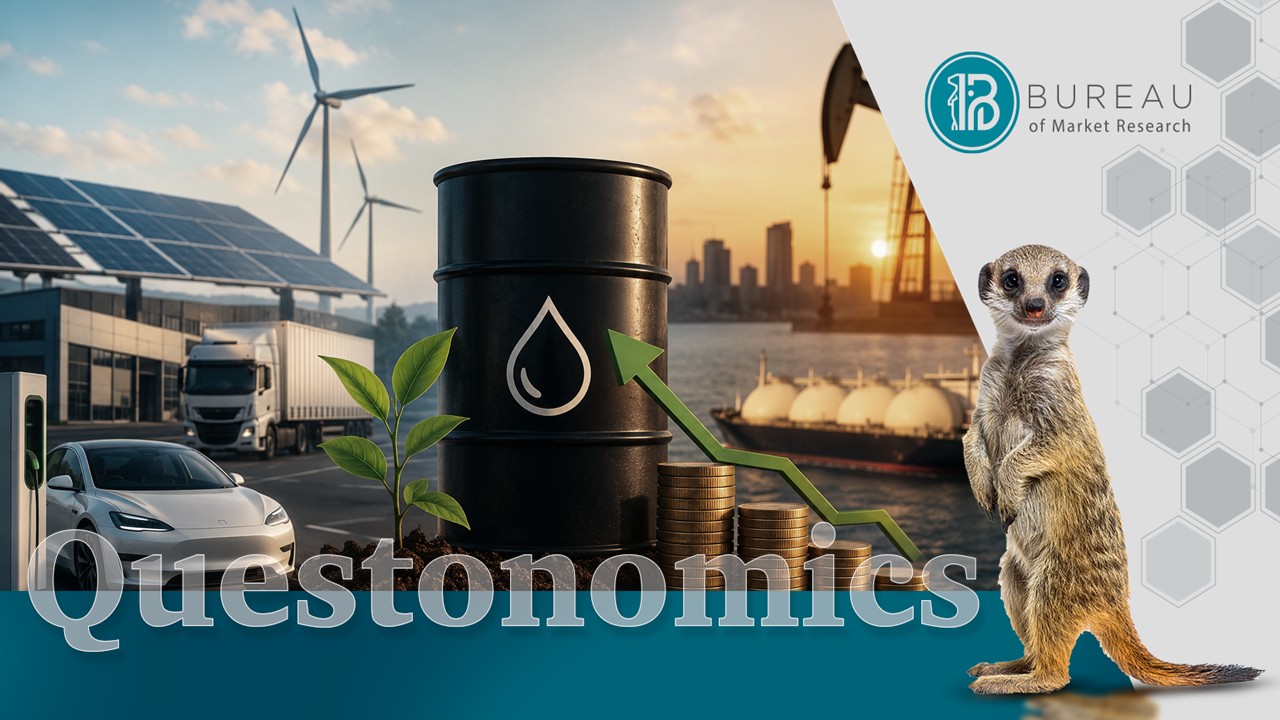
What if rising oil prices are not just increasing costs, but changing the way the world thinks, invests and innovates?
Steven Levitt and Stephen Dubner’s bestselling book Freakonomics popularised one of the most enduring principles in economics, namely that people respond to incentives. This insight provides a powerful framework for understanding how economies, businesses and consumers adapt to external shocks such as the recent rise in Brent crude oil prices, amid heightened geopolitical tensions in the Middle East and concerns over shipping through the Strait of Hormuz.
How oil prices create new economic incentives
The Strait of Hormuz normally carries around 20 percent of the world’s seaborne oil trade. As conflict has increased the risks associated with this vital shipping lane, oil markets have responded with higher prices and greater uncertainty. These higher prices represent a powerful disincentive to continue consuming oil-based products in traditional ways, while simultaneously creating incentives to innovate, diversify and become more energy efficient. Rather than merely absorbing higher fuel costs, governments, businesses and households are adapting in remarkably creative ways.

Diversifying global energy supply chains
One of the clearest responses to higher oil prices has been the redesign of global energy logistics. Instead of remaining dependent on a single strategic chokepoint such as the Strait of Hormuz, oil-producing countries have accelerated investment in alternative export routes. Saudi Arabia has continued to strengthen the strategic importance of its East-West Pipeline linking the Gulf to the Red Sea, while the United Arab Emirates continues to make greater use of its Abu Dhabi–Fujairah pipeline to the Gulf of Oman.
Export infrastructure has also become more diversified. Ports such as Fujairah, Yanbu, Duqm and Jizan are increasingly evolving into integrated energy hubs that combine export terminals, refining capacity, storage facilities, petrochemical complexes and strategic petroleum reserves. Rather than relying on a single export route, both oil producers and importers are building resilient logistics networks capable of withstanding geopolitical shocks. China provides another illustration of how long-term energy security considerations have encouraged diversification. Recognising the strategic risks associated with dependence on Middle Eastern shipping lanes, China has expanded overland oil imports through the Kazakhstan–China pipeline, increased imports via Russia, diversified suppliers in Africa and South America, and expanded strategic storage. Similarly, investments associated with the China–Pakistan Economic Corridor, including Gwadar Port, refinery capacity and storage facilities, represent longer-term efforts to diversify future energy transport options.
Businesses are innovating to reduce energy costs
Businesses have also responded to higher oil prices. Rising fuel costs have strengthened the economic case for technologies such as artificial intelligence, route optimisation software, predictive maintenance and sophisticated fleet management systems that reduce fuel consumption. Many commercial fleets are increasingly replacing conventional vehicles with electric delivery vans, hybrid company cars, battery-powered mining equipment and electric material-handling equipment. Airlines continue investing in lighter aircraft, improved flight planning and sustainable aviation fuels, while shipping companies are deploying LNG-powered vessels, methanol engines, ammonia-ready ships and advanced routing technologies. In each case, higher oil prices strengthen the business case for innovation.
Consumers are changing their behaviour
Consumers are responding in much the same way, namely higher fuel prices improve the economics of battery-electric and hybrid vehicles by reducing their relative lifetime operating costs. Hybrids have become attractive because they offer substantial fuel savings without requiring extensive charging infrastructure. The extent of this shift nevertheless depends on vehicle prices, electricity availability and charging infrastructure, which differ considerably across countries.
Building resilience beyond fuel prices
The response to higher oil prices extends beyond technological innovation. Businesses are redesigning supply chains, shortening transport distances where possible, increasing local sourcing and investing in digital technologies that improve operational efficiency. Financial markets continue directing increasing amounts of capital towards renewable energy, battery technology, charging infrastructure and energy storage, anticipating that these sectors will benefit from a world in which oil prices remain structurally higher and more volatile.
Why oil price volatility matters as much as high prices
There is, however, an important aspect to consider when lamenting higher oil prices. Although Brent crude prices initially rose sharply following the escalation in regional tensions, subsequent market developments have demonstrated how rapidly oil prices can adjust as geopolitical risks, production decisions and demand expectations evolve. Oil prices are ultimately determined by the balance between global supply and demand. Internal dynamics within OPEC and OPEC+, including disagreements over production quotas, changes in output by major producers or decisions by individual members to increase production in pursuit of market share, can significantly offset the inflationary impact of geopolitical conflict. In some circumstances, increased production or weaker global demand may even result in lower oil prices despite continuing tensions in the Middle East. Such volatility itself becomes an additional incentive for governments, businesses and consumers to reduce their dependence on oil, as the objective shifts from responding only to high prices towards reducing exposure to unpredictable energy markets.
The lasting impact of incentive-driven change
Overall, the Middle East conflict demonstrates in practice that people respond to incentives. Higher Brent crude prices are reinforcing investment decisions, influencing consumer preferences, informing government policy and strengthening the economic case for technological innovation across the global economy. Increased oil pipeline use, additional pipeline investment, alternative export ports, electrified transport, artificial intelligence, renewable energy, improved logistics and more efficient production systems are all examples of markets adapting to changing incentives.
Conclusion
Taken together, these developments demonstrate that markets are dynamic rather than static. Higher oil prices undoubtedly impose costs, but they also encourage innovation, accelerate diversification and strengthen incentives for structural adjustment. In the spirit of Freakonomics, incentives reshape behaviour in ways that are often broader and more creative than initially expected. Whether oil prices remain high or eventually moderate because of changing OPEC dynamics, the adaptations already underway are likely to leave a lasting legacy by making the global economy more resilient, more diversified and less dependent on traditional oil-based energy systems.
We welcome your comments and invite you to share your views on our Facebook page.
Compiled by: Prof CJ van Aardt & Ms J Meiring
24 July 2026