


South Africa’s latest inflation figures tell an important story, but not the whole story.
Statistics South Africa reported that annual consumer inflation accelerated to 5.0% in June 2026 from 4.5% in May, reflecting renewed price pressures on South African households after several months of relatively moderate inflation.
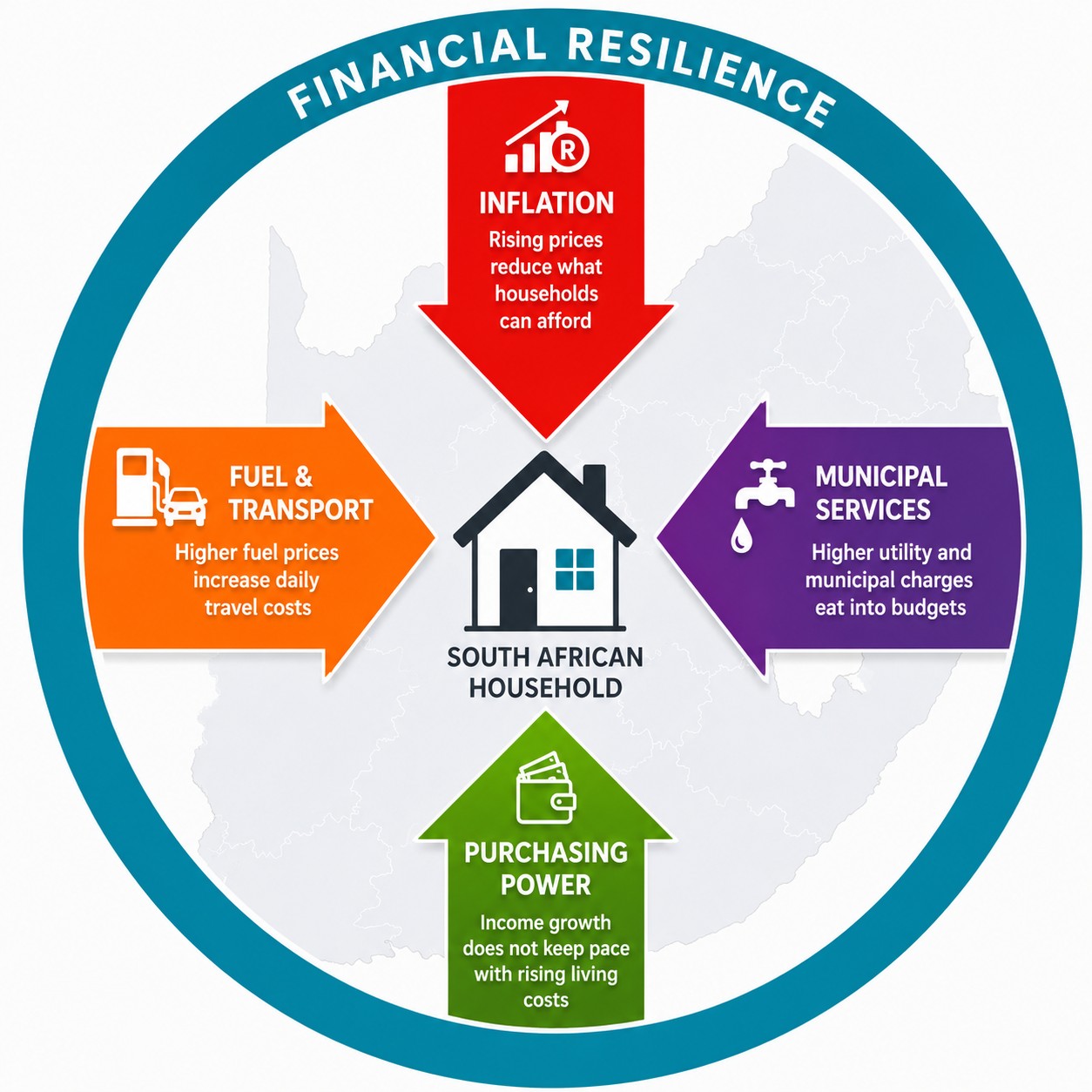
Yet inflation alone does not explain why many South Africans feel financially stretched. The real story lies in how rising prices interact with purchasing power, households’ growing financial obligations and financial resilience.
For businesses, policymakers and market researchers, understanding this broader picture is becoming just as important as monitoring inflation itself.
Recent inflationary pressures have also been influenced by geopolitical developments. Higher oil prices resulting from conflict in the Middle East initially increased transport and fuel costs, but these first-round effects are now filtering more broadly through the economy. As businesses face higher input, transport and distribution costs, many of these increases are gradually passed on to consumers, creating second-round inflationary pressures that extend well beyond the fuel pump. Persistent inflation also has important implications for monetary policy. In an environment where inflationary pressures remain elevated, the South African Reserve Bank may instead need to maintain higher interest rates, or even increase the repo rate, to support its inflation objective. Higher interest rates translate into more expensive mortgage repayments, vehicle finance and other forms of household credit, placing additional pressure on already constrained household budgets and further testing household financial resilience.
Inflation is only the starting point
Headline inflation is an average across hundreds of goods and services, but households do not experience average inflation. They experience the prices of the specific goods and services that make up their own household budget.
The June 2026 Consumer Price Index reveals that inflation is far from evenly distributed across expenditure categories.
The largest increases are concentrated in essential or difficult-to-avoid household expenses. Transport costs increased by 12.7% compared with June 2025, driven largely by a 34.3% increase in fuel prices. Electricity, gas and other fuels increased by 9.9%, while water supply and municipal services rose by 6.9%. Average insurance premiums increased by 6.1%.
By contrast, several categories commonly associated with discretionary spending experienced relatively modest price increases. Clothing inflation measured only 1.2%, footwear inflation 1.0%, while prices for food and non-alcoholic beverages increased by just 1.6%.
Even within food, the picture is mixed. Prices for hot beverages increased by 7.4%, fish and seafood by 4.8% and sugar and confectionery by 2.5%. At the same time some food items were cheaper than a year ago, with fruit prices declining by 10.0%, vegetables by 3.5% and cereal products by 1.5%. Inflation is therefore not evenly spread across the household shopping basket. Instead, the sharpest increases are concentrated in essential household costs that consumers have little choice but to absorb.
The household budget tells a different story
Households can postpone buying new clothes, delay replacing household goods or substitute one food item for another. They have far less flexibility, however, when it comes to commuting to work, paying for electricity and municipal charges or settling insurance premiums. These fixed and semi-fixed expenses absorb an increasing share of monthly income before households have the opportunity to make discretionary spending decisions.
This helps explain why financial pressure can intensify even when inflation in grocery baskets appears relatively subdued. The question facing many households is no longer simply, “How much more does food cost?” Rather, it is, “How much money do I have left after paying for everything I cannot avoid?” The disposable income that remains ultimately shapes demand across much of the economy.
Purchasing power remains under pressure
The pressure on household finances is amplified when income growth fails to keep pace with rising living costs.
Recent findings from the PayInc Net Salary Index (formerly the BankservAfrica Take-home Pay Index) suggest that while nominal net salaries have remained relatively stable, inflation has offset much of the improvement in nominal earnings. As a result, many salary earners are experiencing declining purchasing power despite earning more in rand terms.
This distinction between nominal income and real income is often overlooked. Receiving an annual salary increase does not necessarily improve living standards if everyday expenses are increasing at a similar or faster rate. Households therefore need to stretch each rand further than before, often forcing difficult spending decisions. For many consumers, the issue is no longer whether they have an income, but whether that income still provides sufficient financial flexibility.
A longer-term perspective on financial resilience
While monthly inflation and salary indices provide an important snapshot of current conditions, understanding household financial resilience requires a longer-term perspective.
The BMR’s Personal Income Database, which provides a consistent annual series of South African personal income estimates from 2011 to 2026, shows that income growth has not always translated into stronger purchasing power. After adjusting for inflation, real cash flow income per adult has struggled to keep pace with increases in the cost of living over the past decade. Although aggregate personal income has continued to grow, the average purchasing power available to individuals has remained under pressure.
This distinction is important. A growing economy or rising aggregate income does not necessarily mean that individual households have become financially more resilient. For many consumers, maintaining their standard of living increasingly requires careful budgeting, difficult trade-offs and a greater reliance on financial buffers such as savings or credit. Financial resilience is largely determined by the gap between what households earn, what they must spend on unavoidable expenses and the financial buffers they can draw on when unexpected shocks occur. As unavoidable living costs consume a growing share of disposable income, that gap narrows, leaving households with fewer resources available when those shocks arise.
Money stress is changing consumer behaviour
The financial consequences of rising living costs are increasingly evident in consumer sentiment research.
According to the TransUnion Consumer Pulse Studyfor the second quarter of 2026, inflation remains one of the leading financial concerns among South African households, with nearly four in five respondents identifying it as one of their top three concerns. At the same time, almost two in five consumers expected to miss at least one bill or loan repayment during the coming months.
Consumers are responding by delaying discretionary purchases, cancelling subscriptions, searching more actively for promotions, comparing prices across retailers and reconsidering the use of credit. Rather than eliminating spending altogether, many households are carefully reprioritising their spending to protect essential commitments. This behavioural adjustment has important implications for businesses. Overall demand is not disappearing. Instead, it is becoming more selective, more value conscious and increasingly shaped by affordability, flexibility and trust.
Financial pressure has an emotional dimension
The effects of the cost-of-living crisis extend beyond household budgets. The latest DebtBusters Money Stress Tracker found that 72% of respondents experienced money stress in 2026, a slight increase from the previous year and a reversal of the gradual improvement recorded since 2023. More importantly, the survey found that the cost of living has overtaken interest rates as South Africans’ biggest source of financial stress, with concerns about inflation increasing by 28% and worries about electricity costs almost doubling over the past year.
The tracker also highlights the human impact of sustained financial pressure. Home-life stress reached its highest level since the survey began, while more than half of respondents reported spending over 40% of their take-home pay servicing debt. Financial resilience is therefore influenced not only by income and debt levels, but also by households’ ability to absorb financial shocks without experiencing lasting hardship. A household may still be meeting its financial obligations while experiencing significant financial anxiety. Over time, this can make consumers more risk averse, more cautious about new financial commitments and increasingly sensitive to price increases, affordability and value.
Looking beyond inflation
Taken individually, inflation statistics, salary indices, consumer sentiment surveys and money stress studies each describe one aspect of South Africa’s economic reality. Together with the BMR’s long-term personal income estimates, however, they tell a more complete story. Household financial resilience is being tested not simply because prices are rising, but because many consumers have experienced a prolonged squeeze on real purchasing power while facing increasing unavoidable living costs.
Together, these indicators point towards a common conclusion, namely South African households are operating with increasingly limited financial buffers. Consumers are becoming more deliberate in how they allocate their scarce financial resources. They are protecting essential spending, postponing discretionary purchases, demanding clearer value propositions and carefully weighing every financial commitment. South Africa’s cost-of-living challenge is no longer simply an inflation story. It is a story about financial resilience. For businesses, policymakers and researchers alike, understanding how households adapt when that resilience is tested will become increasingly important for anticipating future consumer behaviour and market demand.
Sources: Bureau of Market Research, Personal Income Database 2026; Statistics South Africa, Consumer Price Index (June 2026); PayInc, Net Salary Index June 2026; TransUnion, Consumer Pulse Study Q2 2026; DebtBusters, Money Stress Tracker 2026.
We welcome your comments and invite you to share your views on our Facebook page.
Compiled by: Ms J Meiring
23 July 2026