


A conflict halfway around the world can affect the prices we pay, the choices we make and the opportunities available to businesses and families at home.
Background
Most commentary on the Middle East conflict understandably starts with the macroeconomic story by focusing on oil prices, inflation, trade disruption, financial market volatility, exchange-rate pressure and weaker economic growth. Although these macroeconomic impacts of the Middle East conflict are significant, it is an incomplete story. Beneath the aggregate macroeconomic numbers, the conflict is also changing the everyday economic decisions of households, firms, workers, investors and governments.
This microeconomic dimension is often the more practical one. It explains why a taxi operator worries about fuel costs before economists debate GDP growth; why a retailer changes suppliers before a central bank revises its forecast; why a household delays buying a car or appliance; and why a small business owner decides whether to absorb higher input costs, raise prices, reduce staff hours or close a product line. The central point is simple, the Middle East conflict is not only moving national accounts, but it is changing incentives, relative prices, risk perceptions, who can produce, who can compete, who can afford to buy and who ultimately carries the burden of adjustment.
Why the microeconomic lens matters
Macroeconomic analysis tells us what happens to the economy as a whole due to the Middle East conflict. Microeconomic analysis shows how those outcomes are produced by millions of individual decisions. In the case of the Middle East conflict, the microeconomic story begins with disrupted supply chains and higher energy prices, but it quickly spreads to pricing behaviour, business confidence, consumer substitution, employment decisions, market concentration, trade routes, insurance costs and government interventions.
This matters because policy mistakes often occur when governments treat the effects of war as a single aggregate shock. The impact is not uniform. Fuel-intensive businesses are affected differently from digital-service firms. Low-income households are affected differently from high-income households. Small firms with limited cash buffers are affected differently from large companies with diversified supply chains. A microeconomic lens therefore helps identify where the pressure points are, who is most exposed and which interventions are likely to work.
The ripple effects of the Middle East conflict can be understood as a chain of economic events. What begins as a disruption to energy supplies and global trade eventually affects businesses, consumers and households around the world. As illustrated below, the economic effects of the conflict ripple through global supply chains before ultimately affecting businesses and households.
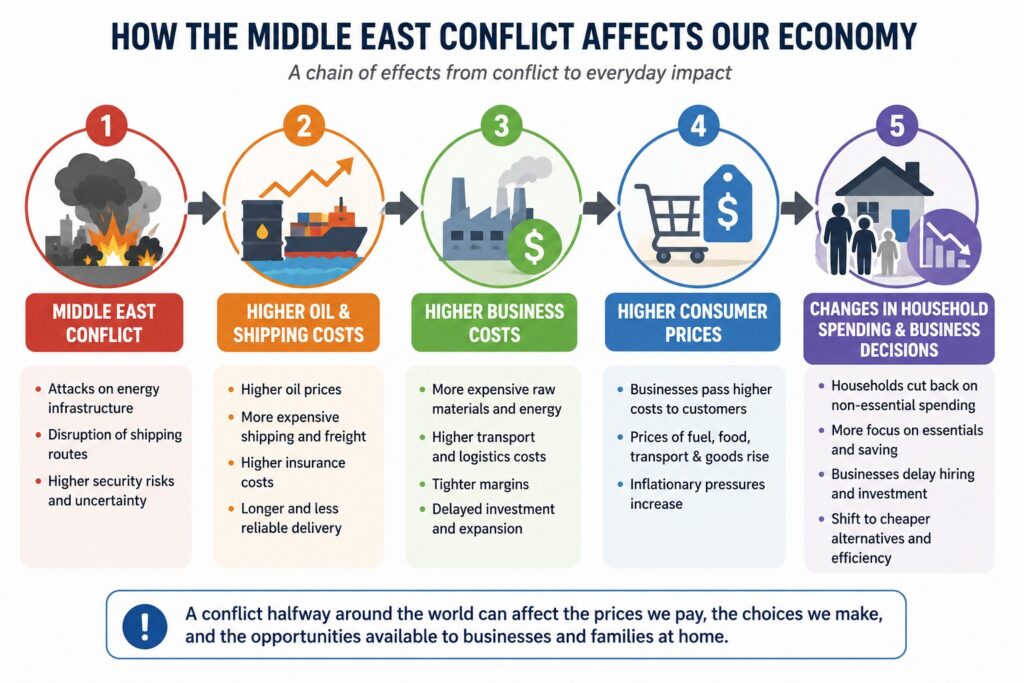
Each stage in this chain creates new challenges for businesses, consumers and policymakers. The following sections explore these effects in more detail.
Supply disruption: the first shock to the system
The most immediate microeconomic impact of the Middle East conflict is a disruption to supply. Armed conflict damages infrastructure, interrupts production, restricts transport corridors, raises security risks and reduces the reliability of delivery schedules. In the case of the Middle East conflict the effect is particularly important because the region is central to global energy markets and contains some of the world’s most strategic shipping routes.
When attacks on oil facilities, the blocking of shipping routes or the creation of maritime chokepoints reduce the expected availability of crude oil or refined products, the supply curve shifts to the left. At any given price, less supply is available or less supply is viewed as reliable. The new market equilibrium is therefore associated with higher prices and lower quantities. This becomes visible in higher fuel prices, freight rates, insurance premiums and the cost of imported intermediate goods. The result is a classic cost-push mechanism at firm level. Businesses that use transport, electricity, packaging, chemicals, plastics, fertilisers, food inputs or imported components face higher input costs. The immediate question for each firm then becomes as to whether this increase can be passed on to customers, absorbed through lower margins, offset through efficiency gains or avoided by changing suppliers.
Higher production costs and the squeeze on firms
Many firms operate with thin margins and limited pricing power. When input costs rise sharply due to the Middle East conflict, firms face a difficult trade-off. If they raise prices too much, customers may reduce demand or switch to substitutes. If they absorb the costs, profitability falls. If they cut production, unit costs may increase further. If they reduce employment, they may protect short-term cash flow but weaken service capacity and morale.
Large firms are generally better placed to manage this environment. They can negotiate bulk contracts, hedge fuel costs, build inventory, diversify suppliers and absorb temporary margin pressure. Small and medium-sized enterprises are more vulnerable because they often lack bargaining power, access to credit and operational flexibility. A conflict-driven cost shock can therefore change market structure by weakening smaller competitors and allowing larger firms to gain market share.
This is one reason why the microeconomic consequences of the Middle East conflict may persist after the immediate shock has passed. Once smaller firms exit, supply networks consolidate and competition weakens. Consumers may then face higher prices not only because costs increased, but because competitive pressure declined.
Higher production costs and the squeeze on firms
Consumers respond to the uncertainty brought about by the Middle East conflict in predictable but powerful ways. When prices rise and the future becomes less certain, households protect essentials. They spend more carefully, delay large purchases, search for cheaper substitutes and increase precautionary saving where income allows. These choices reshape demand across sectors.
Demand for fuel, basic food, electricity, medicine and essential transport is relatively inelastic. Households cannot easily stop consuming these items, even when prices rise. By contrast, holidays, entertainment, restaurant meals, electronics, vehicles and luxury goods are more elastic. Consumers can postpone or reduce these purchases. This means the burden of higher prices falls most heavily on necessities, while the revenue shock is often felt most sharply in discretionary sectors.
The welfare implication is important. A higher fuel price is not merely a line item in an inflation report. For a low-income household, it can mean fewer trips, less money for food, reduced school transport affordability or the postponement of medical visits. For a middle-income household, it may mean delaying a car purchase or cancelling a holiday. For businesses serving these households, it means weaker demand and more volatile revenue.
Investment decisions: uncertainty has an opportunity cost
The Middle East conflict raised uncertainty globally, and uncertainty raises the value of waiting. Firms may still have profitable projects on paper, but they delay committing capital because future costs, demand and exchange rates have become harder to predict. This is especially relevant for investments in factories, equipment, technology, distribution networks and long-term supply contracts.
The opportunity cost of delayed investment is not always visible immediately. A project not started today means jobs not created, productivity not improved and innovation not commercialised. Over time, this weakens competitiveness. At economy-wide level it shows up as slower growth, however, at a micro level it shows up as postponed decisions by individual managers who are unsure whether today’s price signals are temporary or structural.
Foreign investors also become more selective. Capital tends to demand a higher risk premium in uncertain environments. Businesses in or near affected regions may face more expensive funding, reduced investor appetite and tighter credit conditions. Even firms outside the conflict zone can be affected if they depend on trade routes, energy inputs or consumer markets linked to the region.
Labour markets: not only job losses, but job reallocation
The employment effects of the Middle East conflict are uneven. Firms facing lower sales or higher input costs may reduce overtime, cut working hours, freeze hiring or retrench workers. This weakens household incomes and creates a second-round reduction in consumer demand.
At the same time, some sectors may expand. Defence-related industries, cybersecurity, energy exploration, shipping security, logistics, risk consulting and alternative-supply-chain services may require more labour. The labour market therefore reallocates workers from declining to expanding activities. However, this adjustment is rarely smooth. Workers may not have the right skills, live in the right locations or have the financial means to transition quickly.
Trade routes, shipping costs and the price of distance
The Middle East is not only an energy region, but also a geographic hinge in the global trading system. Routes such as the Suez Canal and the Strait of Hormuz matter because they reduce the distance, time and cost of moving goods. With the Middle East conflict raising the risk of using the Strait of Hormuz, shipping firms respond with higher insurance, greater security costs, route diversions or slower delivery schedules.
Longer routes are not neutral. They tie up vessels for longer, reduce shipping capacity, increase fuel use and disrupt inventory planning. Firms that depend on just-in-time delivery may be forced to hold larger inventories, which increases working-capital needs. Retailers then face delayed stock arrivals, higher logistics costs and more difficult pricing decisions.
The final effect is a reduction in consumer surplus. Consumers pay more or wait longer, firms face lower margins or reduced volumes, and the economy allocates more resources to risk management rather than productive expansion.
Competition and market power: crises can redraw the competitive map
The Middle East conflict is directly and indirectly reducing competition in some markets and creating new opportunities in others. Firms with diversified supply chains, stronger balance sheets and better logistics networks can continue operating while weaker firms struggle. This may increase concentration and market power. At the same time, producers outside the conflict-affected region may benefit as firms search for alternative suppliers. This can shift trade patterns and create new regional production opportunities. Countries and firms that can offer reliability, competitive pricing and logistical resilience may gain market share.
The role and limits of government intervention
Many governments across the world are intervening to soften the impact of conflict-related price increases. Instruments may include fuel subsidies, temporary tax or fuel-levy adjustments, strategic petroleum reserve releases, targeted support to affected industries, trade facilitation measures and efforts to diversify import sources.
These interventions can be justified where shocks are severe, temporary and socially damaging. However, they involve trade-offs. Broad subsidies can be expensive and may benefit higher-income consumers more than poorer households. Price controls can create shortages if they discourage supply. Industry support can protect jobs, but it can also delay necessary adjustment if poorly targeted.
A strong microeconomic approach asks three practical questions, namely who is most affected, what behaviour will the intervention change, and who ultimately pays? The best interventions are usually targeted, temporary and designed to preserve essential consumption and productive capacity without permanently distorting markets.
What this means for South African businesses and households
For an open economy such as South Africa, the microeconomic transmission channels associated with the Middle East conflict are especially relevant. Fuel prices affect transport, food distribution, mining, manufacturing and household budgets. Exchange-rate volatility can amplify import-cost pressures. Shipping delays can disrupt retailers and manufacturers. Higher uncertainty can weaken already fragile investment sentiment.
Households, in turn, are likely to respond by prioritising essentials, comparing prices more actively, postponing discretionary purchases and becoming more debt cautious. These micro-level responses can accumulate into weaker demand in sectors such as tourism, hospitality, durable goods and entertainment.
We welcome your comments and invite you to share your views on our Facebook page.
Compiled by: Prof CJ van Aardt
10 July 2026