

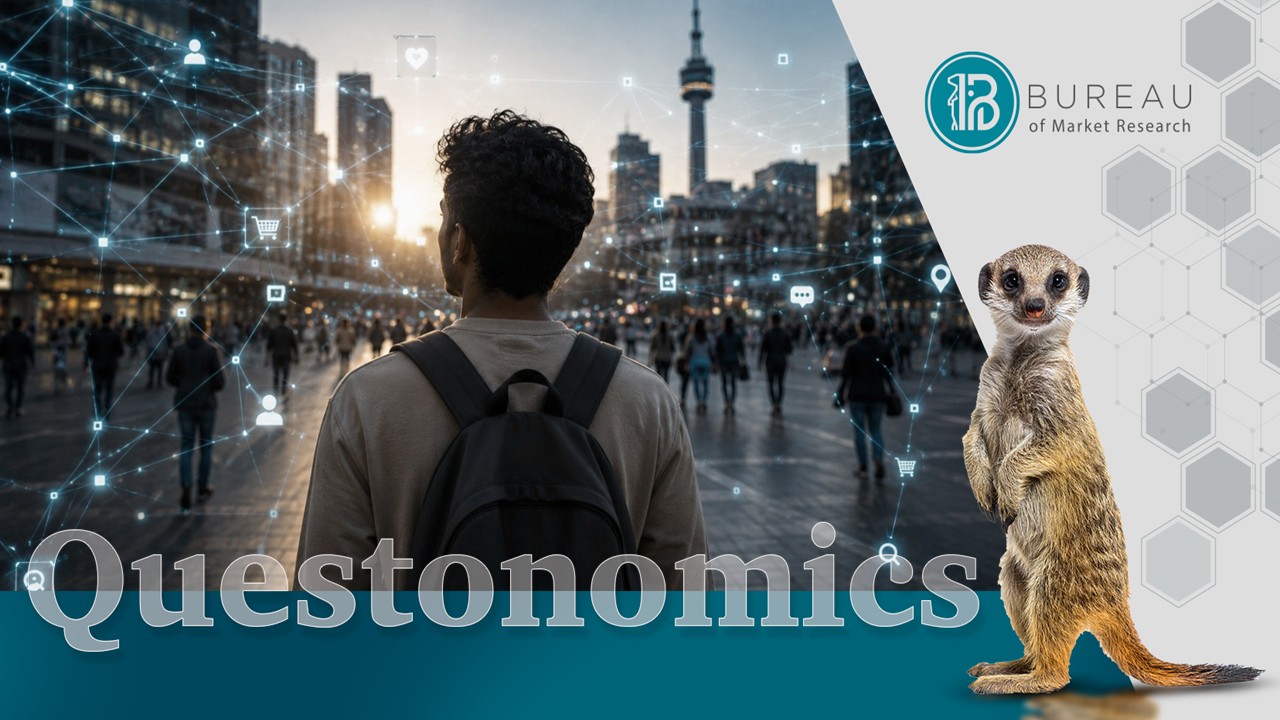
What if the greatest influence on today’s youth isn’t what they choose to see, but what algorithms choose to show them?
As South Africans reflect on Youth Month, conversations rightly focus on education, employment, entrepreneurship and opportunity.
But there is another question worth asking: “What happens when an entire generation grows up inside systems that are continuously learning from them, while they are simultaneously learning from those systems?”
According to BMR’s latest population estimates, nearly 59% of South Africans are younger than 35 years old. Within this broader age group, Generation Z (14 to 29 years of age) and Younger Millennials (30 to 34 years of age) account for more than 22 million people, representing a significant young consumer and working-age segment that is already shaping-or will soon shape- South Africa’s consumer landscape and broader economy.
For these generations or consumer segments, algorithms are not new technologies that arrived later in life. They have always been part of the environment. They recommend what to watch, influence what to buy, determine which news stories appear first, curate social interactions and increasingly shape how people discover interests, build communities, form opinions and make decisions.
For organisations seeking to understand the “young” consumer market, this represents a fundamental shift. Understanding how these generations think is about more than developing effective marketing strategies, namely it is about understanding how “young” consumer behaviour itself is evolving in an increasingly algorithmic world.
For decades, consumer understanding was built on relatively stable foundations. Insight strategists segmented audiences by age, income, geography and life stage, using these variables to understand who consumers were and how they were likely to behave.
These approaches remain valuable. But they no longer tell the full story.
Today, two young South Africans of the same age, living in the same city and earning a similar income may inhabit entirely different digital realities. Even when searching for the same information, they may encounter different content, recommendations and experiences because the algorithms behind their digital platforms have learned different patterns of behaviour over time.
Their information sources differ. Their influences differ. Their communities differ. Their aspirations may differ, not because they belong to different demographic groups, but because they are navigating different algorithmic ecosystems.
At the Bureau of Market Research (BMR), our research increasingly reflects this shift. Traditional demographic segmentation remains essential, but it often cannot fully explain why seemingly similar consumers make fundamentally different choices. To understand today’s consumers, we also need to understand motivation, emotion, trust, digital behaviour and the environments that shape everyday decision-making.
The youth of 1976 (Generation X) challenged systems that controlled access to information. Today’s youth (Generations Z and Young Millennials) navigate a different reality, namely not one of information scarcity, but one of algorithmic abundance.
Information has never been more accessible. Yet much of what people see is filtered, prioritised and personalised by systems that continuously learn from behaviour. Every search, click, view and interaction becomes feedback that shapes the next digital experience.
Young consumers are therefore not simply participating in digital environments. They are growing up within them. As they learn, connect and make decisions, the algorithms around them are learning too, creating a continuous feedback loop between human behaviour and digital systems.
For researchers, marketers, business leaders and insight strategist, this changes the nature of consumer understanding. Technology can reveal patterns. Data can identify signals. Artificial intelligence can generate increasingly sophisticated predictions.
But understanding meaning remains a profoundly human responsibility.
As we reflect on Youth Month, perhaps the most important question is not simply how young consumers behave. It is whether we truly understand the environments in which they are learning to think, trust, decide, engage and behave.
Because if an entire generation is growing up inside systems that are continuously learning from them while simultaneously shaping their experiences, then understanding consumers is no longer enough. We must understand what it means to grow up in the age of the algorithm.
We welcome your comments and invite you to share your views on our Facebook page.
Compiled by: Ms Z Janz
29 June 2026