


As South Africa commemorates Youth Month, millions of young people are still waiting for the opportunity that education alone cannot guarantee: a job.
June is commemorated annually as Youth Month in South Africa and serves as an important opportunity to focus on the aspirations, potential and future contribution of young people to the country’s social and economic development. As South Africa navigates a rapidly changing technological, economic and labour market landscape, the empowerment of youth remains critical to achieving inclusive growth, innovation and long-term prosperity.
Despite their immense potential, many young South Africans continue to face significant barriers to economic participation, including high levels of unemployment, skills mismatches and limited access to sustainable livelihood opportunities. Addressing these challenges requires collaborative efforts to equip young people with the knowledge, skills, resources and opportunities needed to thrive in an increasingly digital and competitive economy. Investing in youth development, entrepreneurship, education and employability is therefore not only a social imperative but also a strategic investment in South Africa’s future.
The labour market data contained in Images 1 to 3, based on the official definition of unemployment, paints a sobering picture of the challenges facing South Africa’s youth. In accordance with Statistics South Africa’s definition of unemployment, youth unemployment refers to individuals aged 15 to 34 years who are not employed, are available for work and have actively sought employment during the reference period. Between the first quarter of 2008 and the first quarter of 2026, youth employment outcomes deteriorated significantly. While South Africa has expanded educational opportunities and implemented various youth development programmes, labour market absorption has not kept pace with population growth and the increasing number of young labour market entrants.
Image 1
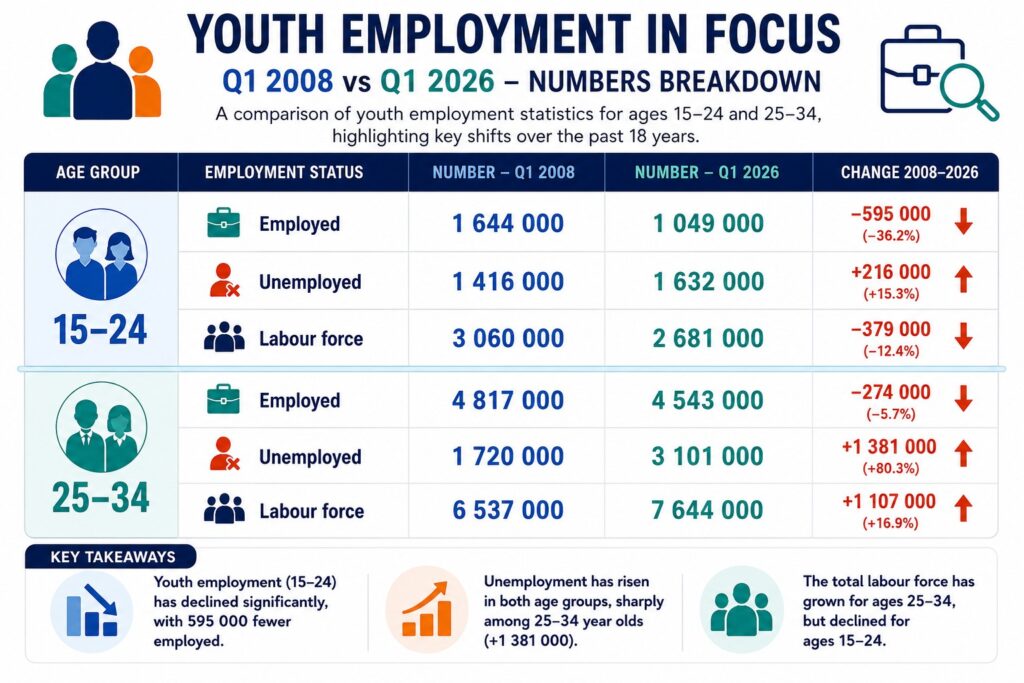
Image 2

Image 3
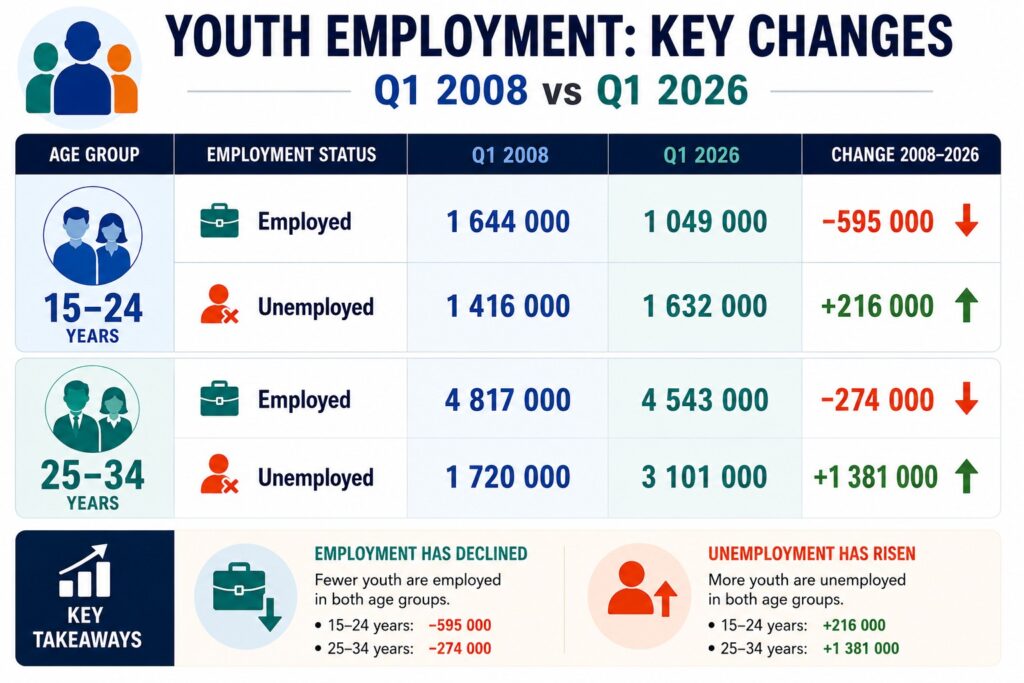
Image 1 shows that for youth aged 15 to 24, employment declined from 1.64 million in 2008 to 1.05 million in 2026. Over the same period, unemployment among 15- to 24-year-olds increased from 1.42 million to 1.63 million. The 15- to 24-year-old labour force contracted from 3.06 million to 2.68 million, suggesting that many young people became discouraged work seekers, remained in education for longer periods and/or struggled to enter the labour market.
Among youth aged 25 to 34, employment declined from 4.82 million to 4.54 million while unemployment increased dramatically from 1.72 million to 3.10 million. The 25- to 34-year-old labour force expanded from 6.54 million to 7.64 million, indicating that labour market growth failed to keep pace with the number of job seekers. Beyond unemployment, South Africa also faces a growing challenge of youth who are not in employment, education or training. This group is particularly vulnerable to long-term exclusion from the labour market and often faces significant barriers to skills development, work experience and economic participation.
These youth labour market trends point to a structural crisis rather than a short-term economic challenge. South Africa’s economy has not generated sufficient labour-intensive growth to absorb young workers. Skills mismatches, weak economic growth, inadequate school-to-work transition systems, limited work experience, spatial inequality, high transport costs, technological change and barriers to entrepreneurship all contribute to persistently high youth unemployment.
The social consequences of this are severe. Youth unemployment contributes to poverty, social exclusion, mental health challenges, crime, substance abuse, delayed household formation and declining social mobility. Young people who remain unemployed for extended periods often experience reduced lifetime earnings and weaker labour market attachment. Communities with high youth unemployment frequently face increased social instability and diminished hope for the future.
The economic consequences are equally significant. High youth unemployment reduces productivity, constrains economic growth, lowers tax revenues, increases dependence on social support systems and limits the country’s ability to benefit from its demographic dividend. Instead of becoming a driver of growth, a large youth population can become a source of economic vulnerability when employment opportunities are absent. Reducing youth unemployment is therefore not only a social imperative but also an economic necessity for achieving sustainable and inclusive growth.
Addressing youth unemployment requires a comprehensive approach. South Africa needs stronger vocational education and apprenticeship systems, improved school-to-work transition programmes, expanded support for SMEs and entrepreneurship, greater recognition of the informal economy, targeted employment incentives, investment in township economies, digital skills development and infrastructure-led economic growth. Public-private partnerships must play a stronger role in creating pathways into work.
As South Africa commemorates Youth Month, the employment status data shown in Image 1 to 3 serve as a reminder that the aspirations of the
youth remain unfinished. The challenge today extends beyond access to education; it includes ensuring meaningful participation in the economy. Creating employment opportunities for young people is one of the most important investments that South Africa can make in its future prosperity, social cohesion and development.
We welcome your comments and invite you to share your views on our Facebook page.
Compiled by: Prof CJ van Aardt, Dr A Basson, Ms P de Jongh & Prof DH Tustin
24 June 2026