

South Africa may be stuck in a low economic growth trap, but the bigger question is whether the well-being of its people is quietly stuck there too.
Introduction
South Africa has experienced persistently weak economic growth over the past decade, with output expanding at rates insufficient to meaningfully raise living standards or absorb new labour market entrants. This has entrenched the widely accepted view that the country is caught in a low economic growth trap. However, GDP alone provides an incomplete picture of societal progress. A more comprehensive assessment requires examining whether well-being – across economic, social and subjective dimensions – is similarly stagnating. The evidence suggests that while certain well-being indicators – particularly those shaped by historical gains and redistributive policies – have demonstrated resilience, South Africa’s overall well-being trajectory is increasingly constrained and fragile. Gains in health, access to services and poverty reduction have plateaued or, in some cases, reversed. At the same time, labour market exclusion, inequality, and financial stress continue to anchor well-being at persistently low levels.
How Well-Being Differs from GDP
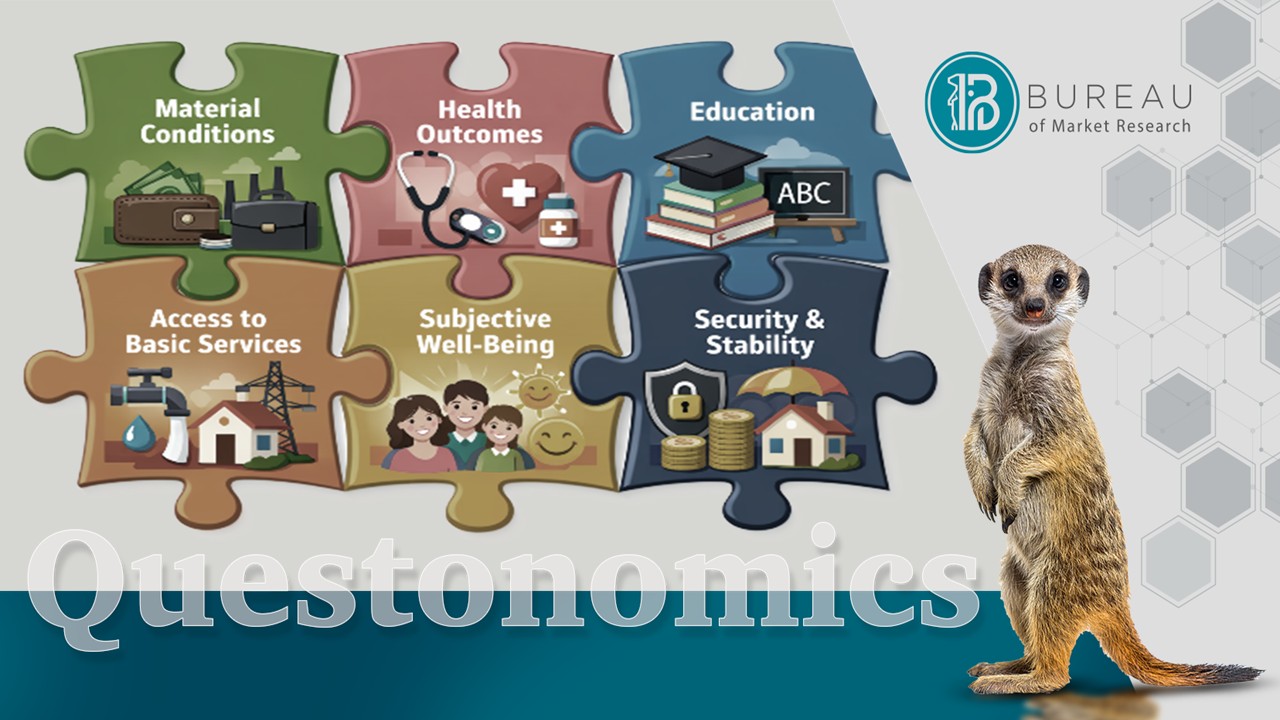
GDP is a unidimensional measure focused on real output growth. In contrast, well-being is inherently multidimensional, encompassing:
- Material conditions (income, employment, consumption).
- Health outcomes (life expectancy, health status, access to care).
- Education (attainment and quality).
- Access to basic services (electricity, water, sanitation, housing).
- Subjective well-being (happiness and life satisfaction).
- Security and stability (financial resilience and exposure to shocks).
This broader lens allows analysts to assess whether improvements in human welfare occur independently of, or alongside, economic growth. It also raises a critical question:
| To what extent can well-being growth serve as an alternative, complementary, or even superior measure to GDP growth – particularly in a country such as South Africa, which appears to be structurally constrained within a low-growth trap? |
The State of Well-Being in South Africa
1. Material Conditions and Employment
At the core of well-being lies employment. South Africa continues to face persistently high – and structurally entrenched – levels of unemployment. The expanded unemployment rate is approximately 40%, with youth unemployment significantly higher. This has profound implications, namely:
- Limited access to income and economic participation.
- Reduced social mobility.
- Increased reliance on social transfers.
Even among the employed, real wage growth has been modest and often outpaced by rising costs of essentials such as food, energy and transport. As a result, purchasing power has eroded, constraining households’ ability to accumulate savings or assets. The labour market, therefore, imposes a structural ceiling on improvements in well-being.
2. Health Outcomes
South Africa has made notable progress in health outcomes, particularly through increased life expectancy following the rollout of antiretroviral therapy, alongside improvements in child mortality and infectious disease management. These gains represent important well-being advances, partially independent of economic growth. However, this progress is increasingly under pressure. Public healthcare systems face capacity constraints, while the burden of non-communicable diseases – such as diabetes and hypertension – is rising. In addition, stark inequalities between public and private healthcare systems persist. While past gains remain significant, future improvements are uncertain and increasingly constrained.
3. Education
Although South Africa has achieved near-universal access to basic education, learning outcomes remain weak. A persistent mismatch exists between the skills produced by the education system and those demanded by the economy. Consequently, education is not translating effectively into improved employment prospects or upward income mobility. This weakens its role as a driver of long-term well-being.
4. Access to Basic Services
Post-apartheid South Africa made substantial progress in expanding access to electricity, water, sanitation, and housing – contributing meaningfully to well-being over time. However, the current challenge has shifted from access to quality and reliability. Increasing electricity instability, water supply disruptions and deteriorating municipal service delivery indicate a transition from expansion to erosion. Past gains are no longer assured.
5. Subjective Well-Being
South Africa consistently ranks relatively low in global measures of happiness and life satisfaction. High levels of unemployment, inequality, poverty and crime contribute to stress, uncertainty and diminished perceived quality of life.
6. Security, Stability, and Financial Resilience
Financial vulnerability among households remains high. Many households lack the capacity to absorb economic shocks due to:
- Rising indebtedness.
- Increased reliance on unsecured credit.
- Low savings rates.
As a result, households are increasingly coping rather than progressing, reflecting a fragile and insecure well-being environment.
Conclusion
South Africa’s well-being trajectory reflects a dual dynamic. On the one hand, there have been important gains – such as improvements in life expectancy, expanded access to services, and higher levels of educational participation. On the other hand, there is clear evidence of stagnation and erosion, driven by labour market exclusion, declining service reliability, persistently high unemployment and deepening household financial vulnerability.
Importantly, the country’s low economic growth trajectory has translated into a constrained and increasingly fragile well-being trajectory.
South Africa is not experiencing a collapse in well-being. Rather, it faces a more insidious challenge, namely the stagnation of well-being at low levels, accompanied by rising vulnerability beneath the surface. Without a decisive shift towards inclusive, employment-intensive growth, improvements in well-being will remain limited – and increasingly difficult to sustain. In this context, well-being growth should not be viewed merely as a substitute for GDP, but as a critical complementary measure – one that, in periods of economic stagnation, may offer a more accurate and policy-relevant reflection of societal progress and lived realities.
We welcome your comments and invite you to share your views on our Facebook page.
Compiled by: Profs CJ van Aardt and DH Tustin
10 April 2026