

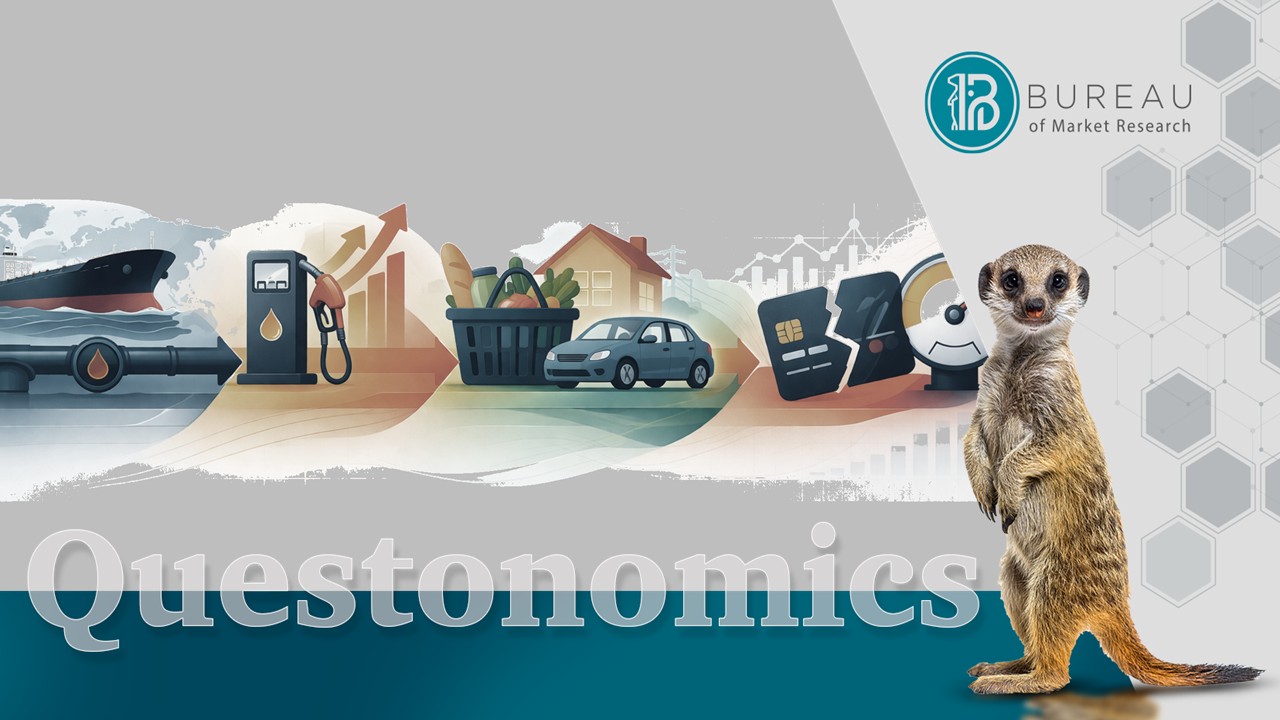
How rising oil prices from Middle East tensions are driving inflation, interest rates, and household credit stress in South Africa.
Background
Geopolitical shocks arising from conflicts rarely remain contained. The ongoing conflict in the Middle East, particularly disruptions involving Iran and the Strait of Hormuz, represents not merely a regional crisis but a global economic shock with far-reaching consequences. What makes this episode particularly significant is its transmission mechanism, namely energy markets. With approximately 20% of global oil supply passing through the Strait of Hormuz, disruptions have triggered sharp increases in oil prices and heightened volatility across global markets. Brent crude has risen above $100 per barrel, reflecting persistent uncertainty and supply risks. For a relatively small, open and energy-importing economy like South Africa, the implications are immediate and are increasingly felt at the household level.
Macroeconomic transmission channels
The economic impact of the Middle East conflict is primarily transmitted through three main channels, namely:
- Oil price shock: The conflict has caused one of the most significant supply disruptions in recent decades, pushing oil prices above $100 and, at times, close to $120 per barrel. This mirrors historical oil crises, where supply constraints rapidly fed into global inflation.
- Inflationary pressures: Higher energy costs ripple through transport, food production (via fertilizers and logistics) and manufacturing inputs. This generates cost-push inflation globally and may compel central banks to delay or reconsider monetary policy easing.
- Slower economic growth: Sustained high energy prices are likely to dampen global growth and trade momentum, particularly in energy-intensive sectors.
South Africa imports the majority of its crude oil and refined fuel, which means that domestic fuel prices are directly linked to global oil prices and the rand-dollar exchange rate. This creates a double vulnerability: higher global prices and currency weakness reinforce one another. Rising oil prices translate rapidly into higher fuel costs, which increase transport and logistics expenses and ultimately feed into broader consumer price inflation. At the same time, higher oil prices can widen the current account deficit and increase borrowing costs as risk premiums rise. The result is a macroeconomic squeeze characterised by higher inflation, weaker growth and tighter local financial conditions.
Household sector transmission channels
Through these macroeconomic dynamics, households face higher fuel costs, rising food prices and increased electricity and transport expenses. As wages and salaries tend to adjust slowly to changing conditions, there is a decline in real disposable income.
As the costs of essential goods and services increases, discretionary expenditure of South African households is reduced as households prioritise basic survival consumption. This weakens domestic demand and further constrains economic growth. In a global context of elevated uncertainty, the risk of broader economic slowdown or recession adds an additional layer of pressure on South Africa as a small, open economy.
Impact on the South African household credit market
The household credit market often reflects economic stress most clearly. Higher inflation contributes to higher or persistently elevated interest rates, as well as increased debt-servicing costs. For already financially vulnerable and highly indebted households, this leads to rising debt-service-to-income ratios and a greater risk of arrears and defaults. Two opposing dynamics are likely to emerge:
- Short-term effect: Households increasingly rely on credit to smooth consumption. This drives higher utilisation of credit cards, personal loans and overdraft facilities.
- Medium-term effect: As affordability deteriorates, demand for new credit weakens while banks tighten lending standards. This results in demand destruction within the credit market.
In a higher-inflation, lower-growth environment, credit quality is expected to deteriorate. Non-performing loans are likely to increase, risk-based pricing will intensify and access to credit may become more unequal. Lower-income households are particularly vulnerable due to their greater reliance on unsecured lending and informal credit markets.
Concluding remarks
The Middle East conflict illustrates how external shocks are transmitted through energy markets into domestic economies and ultimately into household finances and credit dynamics. The transmission chain is clear, namely conflict leads to higher oil prices, which drives price inflation, which in turn sustains higher interest rates, placing pressure on household credit markets. What makes this current situation particularly challenging is that South African households are already facing high levels of financial vulnerability, unemployment, poverty and indebtedness. The Middle East conflict does therefore not create household vulnerabilities but rather intensifies existing ones. Should the conflict persist and energy prices remain elevated, the risk for South Africa extends beyond a temporary increase in inflation. The more pressing concern is a prolonged period of household financial strain, where credit becomes both a necessary coping mechanism and a growing source of systemic risk.
We welcome your comments and invite you to share your views on our Facebook page.
Compiled by: Ms J Meiring & Prof CJ van Aardt
26 March 2026