

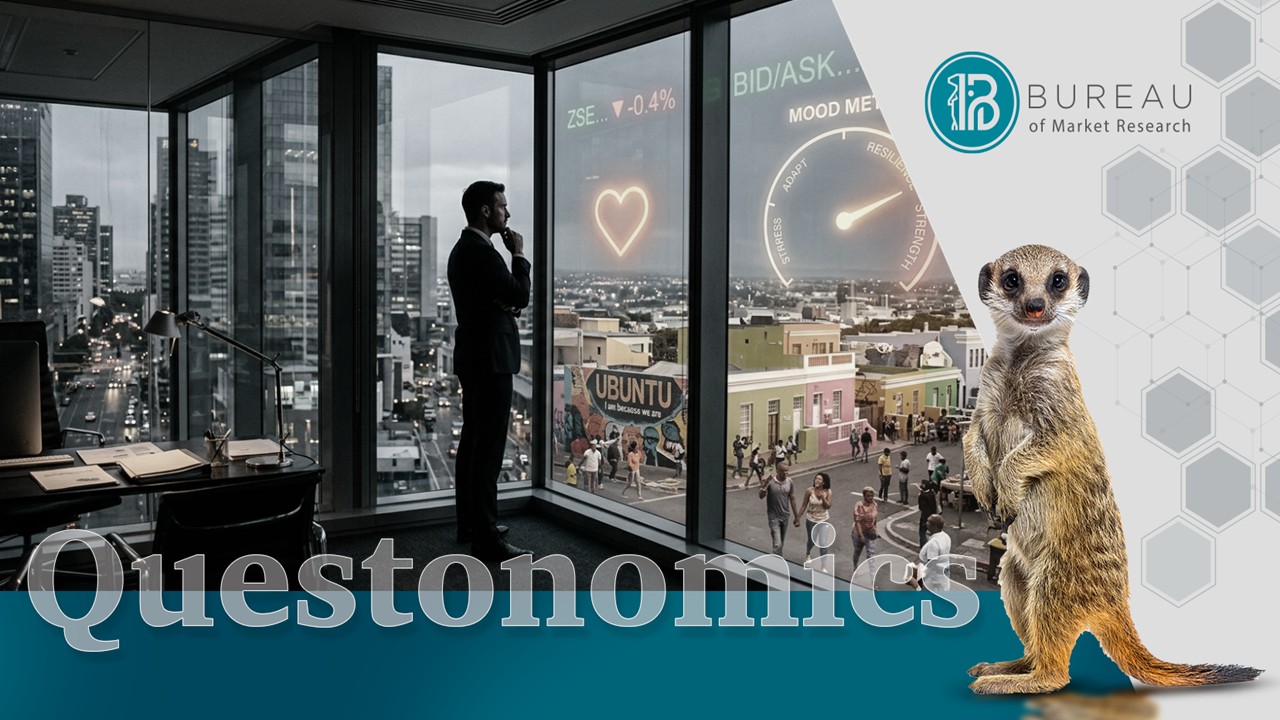
We’ve been staring at the same economic dashboards for decades. But what if the most important indicator isn’t on the screen?
We analyse South Africa’s economy constantly…
- GDP growth.
- Unemployment rates.
- Inflation.
…but we may be measuring the wrong thing.
These metrics dominate our boardrooms, yet they are increasingly failing to explain a fundamental reality: How does South Africa keep going?
In traditional economics, a system under this much pressure – economic strain, institutional scepticism and geographic isolation – should be brittle. Yet it isn’t. It remains remarkably resilient. To understand why, we need to look at the one indicator that is rarely discussed in boardrooms or economic reports: The national mood.
The national mood is not simply a “vibe” or a social byproduct. It is a primary economic input, because the way people feel about the future directly shapes how economies behave. When people believe progress is possible, spending increases, entrepreneurship becomes attractive, productivity improves and participation in the economy grows. But when opportunity feels distant, the natural human response is to disengage. People postpone purchases, avoid risk, disengage from work and stop pursuing opportunities that feel unattainable.
Yet South Africa possesses a structural characteristic that helps explain why the system does not simply collapse: antifragility.
Economist Nassim Nicholas Taleb coined the term antifragility to describe systems that do not merely survive shocks but actually become stronger because of them.
A fragile system breaks under stress. A resilient system resists it. But an antifragile system requires stress to grow.
Many South Africans have spent years navigating economic pressure, uneven service delivery and uncertainty about the future. In rural communities and among young people in particular, opportunity can often feel distant. Yet despite these pressures, something important continues to hold. Communities still organise. Churches still gather people. Sport still connects neighbourhoods. Families and informal networks continue to support one another in ways that rarely appear in economic statistics.
This resilience matters more than we often realise.
But what is the engine driving this antifragility? Why don’t we just shatter?
South Africa’s resilience is often described through the idea of Ubuntu – the belief that individual wellbeing is inseparable from collective wellbeing. If antifragility is the structural result, Ubuntu may be the mechanism that makes it possible for a society to remain resilient even when the national mood is strained.
The philosophy of “I am because we are” is therefore more than a sentiment. In economic terms, Ubuntu reminds us that markets do not function in isolation from society. Trust, dignity and belonging influence how people participate in economic life.
For businesses operating in South Africa, this realisation changes everything. It means that the national mood is not something happening outside the market – it is part of the market environment itself. Consumer confidence shapes demand, workforce wellbeing shapes productivity and community stability shapes operational risk. Trust in institutions and brands also becomes more fragile when public morale is low.
Companies that recognise this dynamic increasingly understand that wellbeing and economic performance are deeply connected. If morale influences participation, and participation drives economic performance, then the emotional climate of a country is not peripheral to growth – it is part of its foundation. Supporting community wellbeing is therefore not simply about corporate responsibility or philanthropy. It is about sustaining the conditions under which markets function effectively and remain antifragile.
The bottom line is that despite the pressures facing Mzansi, the country’s social fabric has not collapsed. Community networks remain strong, youth ambition still exists and local leadership continues to emerge across towns and rural areas.
South Africa’s mood may be fragile, but it is far from broken. Strengthening hope, trust and opportunity is therefore not only a social priority. It is an economic one.
Because ultimately:
A country does not grow only when policies improve. It grows when people believe improvement is possible.
Perhaps the real question for business leaders is this: Are we measuring the wellbeing that drives the economy – or only its outputs?
We welcome your comments and invite you to share your views on our Facebook page.
Compiled by: Ms Z Janz
Date: 2026-03-20