


What if the average business in an economy earns just 1.3% profit?
That is the reality facing South African companies today. According to Statistics South Africa’s latest Annual Financial Statistics, the average after-tax profit margin across all businesses in 2024 was only 1.3%.
Margins this thin leave companies with almost no room to absorb shocks, invest in growth or expand employment. In many sectors, businesses are not operating with healthy profitability, they are operating on survival margins.
It is evident from the H2 2025 Absa/SACCI/BMR Small Business Growth Index (SBGI) that small businesses are under huge financial pressure to survive. At the core of financially struggling businesses in South Africa appears to be a huge profitability problem. According to the latest data from Statistics South Africa, after-tax profit margins across sectors and business sizes are extremely low. In 2024 – the latest year for which Annual Financial Statistics were published by Statistics South Africa – the overall after-tax profit margin across all businesses was just 1.3%. This figure is not merely low, but it is also structurally concerning. When average profitability across an entire economy prevails at 1.3%, firms are operating with very little cushioning against risk, volatility or unexpected shocks. The data in the sectoral breakdown shown in the table below discloses this distress.
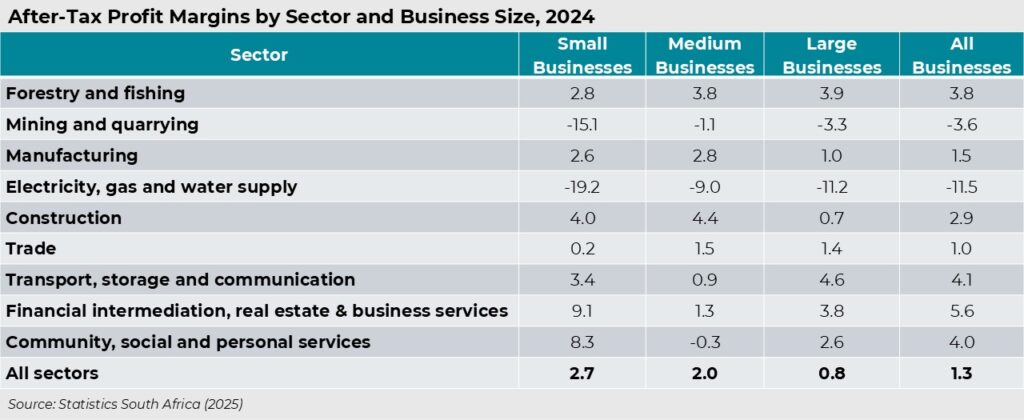
Several key points immediately stand out from the data. Firstly, the mining and quarrying sector posted a negative overall margin of –3.6%, while the electricity, gas and water supply sector recorded a deeply negative profit margin at –11.5%. It is also disconcerting that manufacturing, which is central to industrialisation and job creation, managed to generate a profit margin of only 1.5%. The trade sector, one of the largest employers in the country, operated at a profit margin of just 1.0%. Even large businesses across all sectors averaged a profit margin of only 0.8%. These are survival margins.
Why thin profit margins matter for businesses and the country as a whole
Low profit margins are not just a corporate concern. They shape the entire growth trajectory of the economy. It needs to be considered in this regard that profits are the primary internal source of reinvestment. When margins are thin retained earnings shrink, businesses rely more on debt, investment becomes highly sensitive to interest rates changes and risk tolerance declines. In South Africa’s context, where interest rates remain elevated and uncertainty persists, thin margins raise the hurdle rate for new projects. Even moderately risky investments become unattractive if expected returns barely exceed operating costs. The result of this is that capital formation slows, and long-term growth weakens.
In many countries, capital expenditure increases productive capacity. In South Africa, however, a significant share of business investment is defensive, i.e. in the form of investments on backup power systems, water storage, security infrastructure and redundant logistics solutions. Although such defensive investments stabilise operations, it does not expand output. Especially when profit margins are only 1 to 2 percent, businesses must choose between survival investments and growth investments, resulting in growth being postponed.
Furthermore, becauseinvestment drives productivity, i.e. investments in new machinery, digital systems, training and logistics improvements, all raise output per worker. Conversely, if firms cannot accumulate capital because profits are thin, productivity growth slows, unit costs remain high, international competitiveness weakens and wage growth becomes constrained. In this way a self-reinforcing negative cycle emerges, namely low productivity suppresses margins, and low margins suppress productivity-enhancing investment.
It is not just productivity that suffers under a low profit scenario, but employment growth also becomes fragile because hiring decisions depend on a large extent on expected profitability. When margins are razor-thin, businesses hesitate to expand headcount, temporary contracts become more attractive, wage increases are limited and job creation slows. This dynamic helps explain why even modest GDP growth in South Africa does not translate into strong employment gains.
In the same way that job creation suffers when there are low profit margins, entrepreneurship and economic risk-taking also suffer. Entrepreneurship requires upside potential. If margins are structurally low across sectors, start-up incentives decline, innovation slows, businesses avoid long-term projects and strategic expansion becomes rare. The net result of this is that any economy operating in survival mode struggles to generate transformative growth which in turn gives rise to inclusive growth.
Low-margin businesses have limited buffers giving rise to higher levels of financial fragility. They are more vulnerable to interest rate increases, input cost spikes, exchange rate volatility and infrastructure shocks. In South Africa’s volatile operating environment, thin margins amplify risk exposure.
Finally, investors compare risk-adjusted returns globally. If after-tax returns are persistently low while risks are high, domestic capital may move offshore, foreign direct investment declines and portfolio capital becomes more volatile. In the case of South Africa where profitability is very low relative to risk, this undermines South Africa’s attractiveness as an investment destination.
The bigger picture: A low-growth trajectory
An economy’s profit share (capital share) and labour share together determine how income is distributed and how capital accumulates. If profit margins are very low across the board, capital accumulation slows, labour productivity growth weakens and wage growth stagnates. This, in turn, impacts negatively on domestic demand, while lower domestic demand further negatively impacts on economic growth. As a result the South African economy already became trapped in a low-growth trajectory characterised by limited investment, fragile employment growth and subdued productivity.
Given this adverse situation the question could now be asked: What can be done to address the low profit margin situation?
As part of the potential solution, it is important to note from international experience that it is not an optimal solution to artificially inflate profit margins. It is rather an optimal solution to address the structural constraints that compress them. Such constraints that need to be addressed include inter alia unreliable electricity and logistics, high levels of regulatory friction, weak municipal governance, high levels of policy uncertainty, low levels of productivity and unnecessary business costs. With an overall after-tax profit margin of just 1.3%, South Africa faces a structural profitability constraint that directly limits its capacity for investment, job creation and sustained growth. Until profit margins rise the country’s growth trajectory is likely to remain modest and fragile.
We welcome your comments and invite you to share your views on our Facebook page.
Compiled by: Prof CJ van Aardt
12 March 2026