

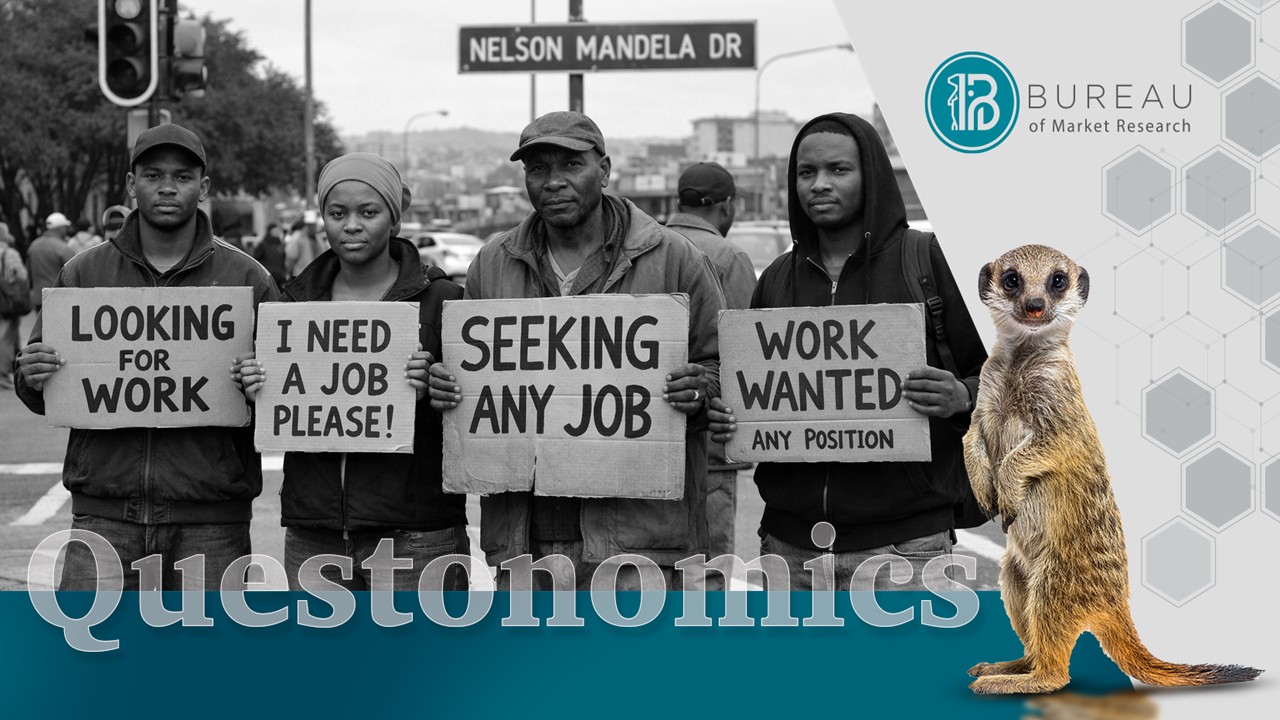
South Africa’s unemployment crisis may ease slightly by 2028, but without structural reform, real progress will remain slow.
South Africa’s labour market remains under strain. The latest QLFS release (Q4:2025, published 17 February 2026) confirms that while there are small improvements, recovery is slow and fragile.
Where We Stand at the End of 2025
The official unemployment rate declined from 31.9% in Q3 2025 to 31.4% in Q4. The number of officially unemployed people fell from 8.007 million to 7.836 million. On the surface, that looks positive. But once discouraged work seekers are included, the expanded unemployment rate actually increased slightly from 40.2% to 40.3%. In other words, many South Africans remain disconnected from the labour market.
Employment rose marginally from 17.055 million to 17.099 million, yet the labour absorption rate edged down from 40.7% to 40.6%. Job creation is not keeping pace with population growth. The labour market is not collapsing, but it is not meaningfully improving either.
What Could 2028 Look Like?
By Q4:2028, projections suggest cautious, incremental improvement:
- Official unemployment rate declining to around 30%.
- Expanded unemployment easing to about 40%.
- Employment-to-working-age ratio improving from 40.7% to approximately 41.1%.
Even if achieved, these are modest gains. South Africa would still have exceptionally high unemployment by global standards. Progress depends heavily on stronger growth between 2026 and 2028, improved business confidence, and better infrastructure performance – especially electricity and logistics.
Why Progress Remains Limited
Several structural constraints continue to weigh on employment:
- Skills mismatches
- Regulatory rigidities
- Infrastructure bottlenecks
- Governance weaknesses
- Weak fixed investment
- Fiscal constraints
- Policy and political uncertainty
There is no shortage of people willing to work. The shortage is in conditions that make hiring rational and sustainable.
What Must Change to Accelerate Job Creation?
Three conditions must align:
- Firms must want to expand.
- Workers must be employable.
- The institutional environment must lower risk.
If any one of these fails, job creation stalls.
Key reforms include:
- Fixing energy and logistics at scale: Electricity stability, transmission expansion, improved ports, rail reform and freight competition.
- Simplifying regulation for small businesses: Reducing compliance costs, licensing delays and municipal inefficiencies. The second wave of the Absa/SACCI/BMR Small Business Growth Index shows regulation is materially constraining growth.
- Reforming youth labour market entry: Wage subsidies, expanded learnerships, apprenticeship incentives and probation flexibility to reduce hiring risk.
- Strengthening entrepreneurship and vocational training: More artisans, technicians and entrepreneurs; stronger TVET alignment and dual training models.
- Improving municipal governance: Water, zoning certainty, waste management, policing and property rights directly influence job creation.
- Expanding digital inclusion: Affordable broadband and digital skills enable entrepreneurship and remote services exports.
- Ensuring policy stability: Tax certainty and regulatory consistency reduce investment hesitation.
The Bottom Line
Between 2025 and 2028, employment is likely to improve, but gradually. Unemployment may fall slightly, and participation ratios may rise modestly.
However, incremental gains will not solve a structural problem.
Sustained job creation requires deliberate alignment between growth, capability and confidence. Without structural reform, stronger governance, better infrastructure and policy certainty, progress will remain slow.
South Africa’s labour market does not need optimism. It needs execution.
We welcome your comments and invite you to share your views on our Facebook page.
Compiled by Prof CJ van Aardt
25 February 2026