

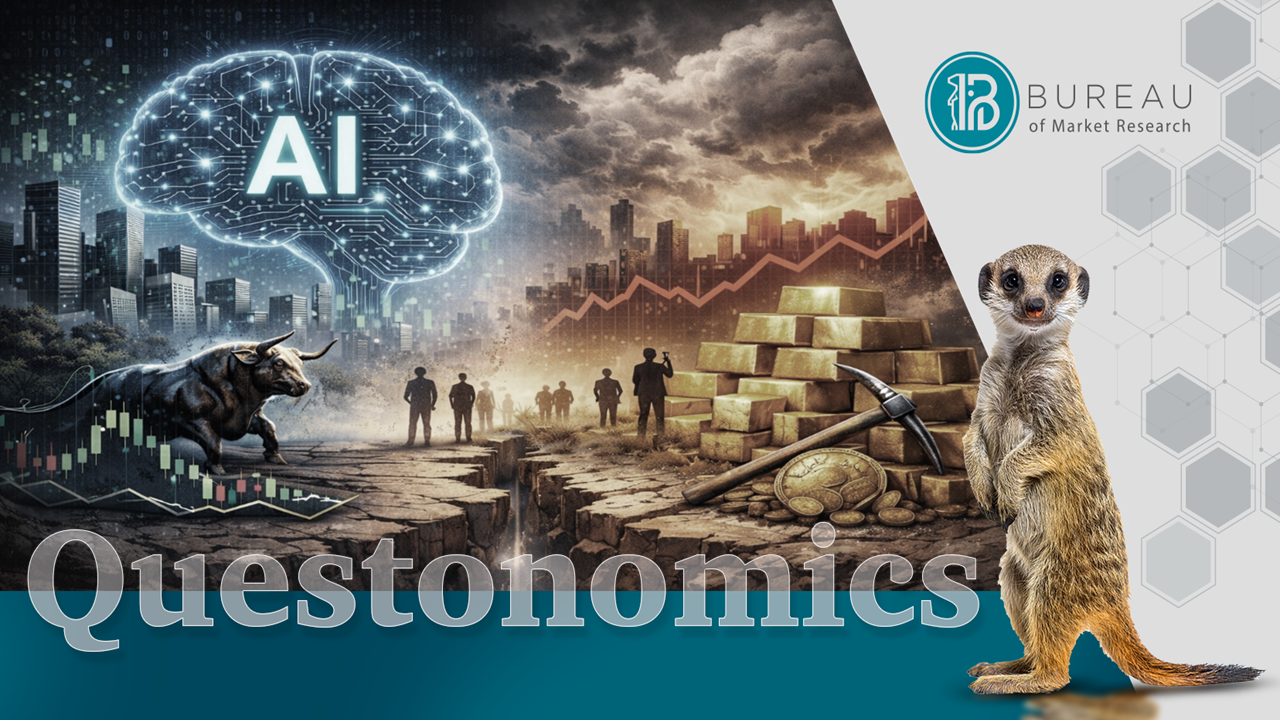
When intelligence escapes biology and signals become harder to trust, will markets chase the future – or insure against it?
Artificial intelligence is no longer a speculative concept or a distant promise; it is rapidly becoming embedded in infrastructure, corporate strategy and competitive advantage. Equity markets reflect this reality, namely investors continue to push valuations higher as companies race to position themselves at the centre of the AI transformation. In 2025 alone, the S&P 500 recorded 38 new all-time highs driven by AI equities. However, in this world driven by enthusiasm around AI, safe haven assets traditionally associated with caution and insurance are also rising sharply, thereby telling a different part of the story.
Gold prices traded at record highs, surpassing US$5,000 per ounce – levels more commonly linked more to crisis than confidence. Risk and refuge are moving higher together, revealing a market caught between belief and doubt, namely while believing in AI’s long-term potential there is doubt about the path it will take to get there.
This tension is not without precedent. Periods of transformative innovation have often been accompanied by excess and repricing. The dot-com era offers a useful parallel, where optimism around the internet drove extraordinary equity valuations. When that bubble burst in the early 2000s, confidence in equity markets collapsed. Between 1999 and 2011, as investors withdrew from stocks and central banks lowered interest rates, the price of gold rose more than 620%. Technology went on to reshape the global economy, but not before markets relearned humility.
The current rise in the gold price should not be read as a rejection of artificial intelligence. Gold remains an essential material in advanced electronics and data infrastructure. However, its rising price reflects something deeper than industrial demand. In this environment, namely gold functions less as an alternative to technology and more as insurance against misplaced certainty.
At forums such as the World Economic Forum in Davos, leaders increasingly describe artificial intelligence in dual terms, namely something of extraordinary potential but with inherent systemic risk. Elon Musk has referred to AI as a “double-edged sword,” capable of immense value creation and profound disruption. That duality is increasingly visible not just in rhetoric, but in market positioning.
When narratives begin to dominate valuations, investors tend to gravitate toward assets that sit outside the prevailing story. The resulting pattern is familiar. Optimists buy technology. Pessimists buy gold. Hedgers buy both. The coexistence of these positions suggests a market structured not around a single conviction, but around the possibility that expectations and valuations may be advancing faster than verifiable fundamentals. As intelligence escapes biology and signals become harder to trust, markets are not choosing between chasing the future or insuring against it, but are rather doing both. In that contradiction lies the clearest signal of all: not confusion, but a market that does not trust itself.
We welcome your comments and invite you to share your views on our Facebook page.
Compiled by: Ms Z Janz
5 February 2026